SUMMARYResearchers at Pennsylvania State University developed a conductive ink that can be painted directly onto skin in colorful custom designs and dries into a functional electrode for biomonitoring. The work, published in Proceedings of the National Academy of Sciences, aims to make epidermal electronics more usable on curved or hairy body areas where traditional temporary tattoo sensors struggle. The approach could support more flexible wearable biosensors for measuring signals such as temperature, strain, and other physiological data.
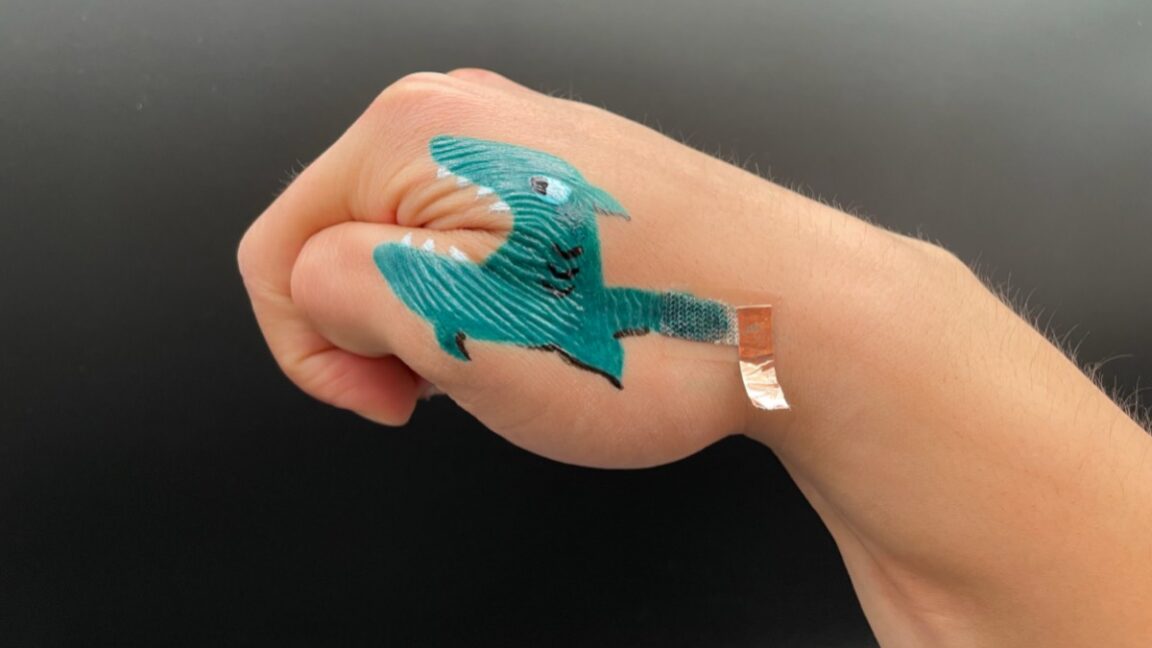
Credit: Wanqing Zhang
Scientists at Pennsylvania State University have developed a novel conductive ink that can be painted directly onto the skin in colorful custom designs, turning into a functional electrode for biomonitoring after drying. They described their work in a new paper published in the Proceedings of the National Academy of Sciences (PNAS).
As previously reported, epidermal electronics attached to the skin via temporary tattoos (e-tattoos) have been around for more than a decade. So-called e-tattoos connect to skin without adhesives, are practically unnoticeable, and are typically attached via temporary tattoo, allowing electrical measurements (and other measurements, such as temperature and strain) using ultra-thin polymers with embedded circuit elements.
However, these e-tattoos have their limitations, most notably that they don’t function well on curved and/or hairy surfaces, as well as requiring personalized electrode placement design to cover larger areas, since biosignals are spatially distributed. So scientists have been getting creative. For instance, in 2024, researchers developed special polymer-based conductive inks that can be printed onto a person’s scalp to measure brain waves, even if they have hair. This could one day enable mobile EEG monitoring outside a clinical setting, among other potential applications.