SUMMARYNVIDIA announced a five-year, $250 million U.K. compute commitment to support agentic safety and security research, along with annual accelerated-computing access at Oxford, UCL and Imperial College London. The company also joined the Earthshot Prize as a founding global alliance partner to help climate and sustainability innovators. Across the U.K., partners are deploying AI in healthcare, banking, smart cities, science and quantum research, including new models and infrastructure from OneAdvanced, Revolut, Lloyds, NatWest, Riverlane and others.
blogs.nvidia.com
Across industries, the U.K. is putting the full stack to work — and the scale of deployment is growing fast, from enterprises transforming their businesses to startups solving some of the planet’s hardest problems.
NVIDIA is putting that principle into practice, including through a five-year, $250 million compute commitment to strengthen the U.K.’s agentic safety and security research, providing $50 million in accelerated computing access annually through BOLD at the University of Oxford, SOFAIR at UCL and Imperial College London.
In addition, NVIDIA is partnering with the Earthshot Prize, joining as a Global Alliance Founding Partner to bring compute and technical expertise to innovators working on solutions for the world’s greatest climate and sustainability challenges.
Technology Leaders Pioneer Intelligent Solutions Across the UK
In energy, Fuse Energy is moving its customer AI onto its own in-house infrastructure, built on NVIDIA B300 Blackwell Ultra, delivering faster, more responsive support to over 450,000 U.K. households.
Meanwhile, sovereign AI company Locai Labs released Nemotron-Personas-UK — an open source dataset of one million synthetic personas representing the UK’s demographic, regional and cultural diversity — helping developers build fairer, more representative AI systems.
Healthcare
In healthcare, OneAdvanced is deploying what it calls the U.K.’s first and most advanced fine-tuned LLM for Primary Care AI-triage — built with NVIDIA Agent Toolkit software and open models — supporting millions of National Health Service patients.
Heidi has now integrated NVIDIA Nemotron open models to give clinicians faster access to trusted medical evidence.
Speechmatics is deploying Oak, a multilingual medical speech recognition model, using NVIDIA Triton Inference — giving healthcare organizations control over where sensitive patient audio is processed.
Apian, SYNLAB and NVIDIA are teaming up to use advanced computing and digital simulations using NVIDIA Cosmos to help hospital robots handle the heavy lifting of moving lab samples, freeing up medical staff to focus on patient care.
Danaher and NVIDIA are collaborating to advance autonomous science and help accelerate the pace of discovery by bringing accelerated computing, scientific and physical AI into laboratory workflows and instruments. Danaher’s recently announced AI-powered autonomous lab — designed to deliver up to 8x faster discovery of affinity reagents — is using NVIDIA BioNeMo open models within its AI-driven protein design workflows, data and automation technologies that connect design with experimental feedback.
Smart Cities
On the civic side, Liverpool City Region is building an NVIDIA-powered “City Brain” — a sovereign AI strategy designed as a blueprint for dozens of Unitary Authorities across the U.K.
Digital Jersey, Innovation City Belfast and Tees Valley Combined Authority are each exploring how trusted AI compute can serve communities and public services.
Financial Services
In financial services, LSEG and NVIDIA are bringing GPU-accelerated market analytics to global institutions.
Revolut introduced PRAGMA earlier in the year — a foundation model for banking event sequences, pre-trained on 26 million anonymised user histories. PRAGMA has moved from research to real-time scaling.
Lloyds Banking Group built ATUM, a transaction foundation model that converts billions of banking transactions into reusable AI. And Starling is developing a banking foundation model trained on Civo’s U.K. sovereign cloud infrastructure.
NatWest is collaborating with NVIDIA on Nemotron Voice to better understand how banking customers across the U.K. speak, while Modulr is deploying a network of agents using Nemotron for distinct parts of payment operations.
Quantum
Quantum is moving from research to systems deployable alongside classical AI, and the U.K. is at the heart of this shift.
Riverlane has shown how GPUs can accelerate decoder recalibration workflows used in quantum error correction, helping decoder performance keep pace with real-time changes in quantum hardware behaviour. The work forms part of a broader collaboration exploring how AI, accelerated computing and quantum error-correction technologies can work together to support future quantum systems.
Together, these announcements showcase how enterprises, organizations and startups in the U.K. are fostering innovation across the nation. This includes more than 3,100 U.K. companies that are a part of the NVIDIA Inception program for cutting-edge startups.
Tune in to NVIDIA founder and CEO Jensen Huang’s GTC Berlin keynote on Wednesday, Oct. 21, at 11 a.m. CEST.
SUMMARYEuropean cities and regional partners are deploying NVIDIA-powered physical AI agents, digital twins and local AI factories to improve urban operations, public services and infrastructure management. Projects in the U.K., France, Italy, Belgium and Sweden include tools for mobility planning, energy efficiency, compliance, safety, citizen chatbots and event crowd previews, with some systems cutting document search time from weeks to minutes and reducing operating costs.
blogs.nvidia.com
Keeping a city running means making decisions that affect residents every day — from when to repair a road to how to use energy more efficiently.
Across the EMEA region, cities and local software, infrastructure and integration partners are using NVIDIA accelerated computing to build physical AI agents and digital twins that help teams make those decisions. These applications can anticipate maintenance needs, guide urban planning and make public services more responsive.
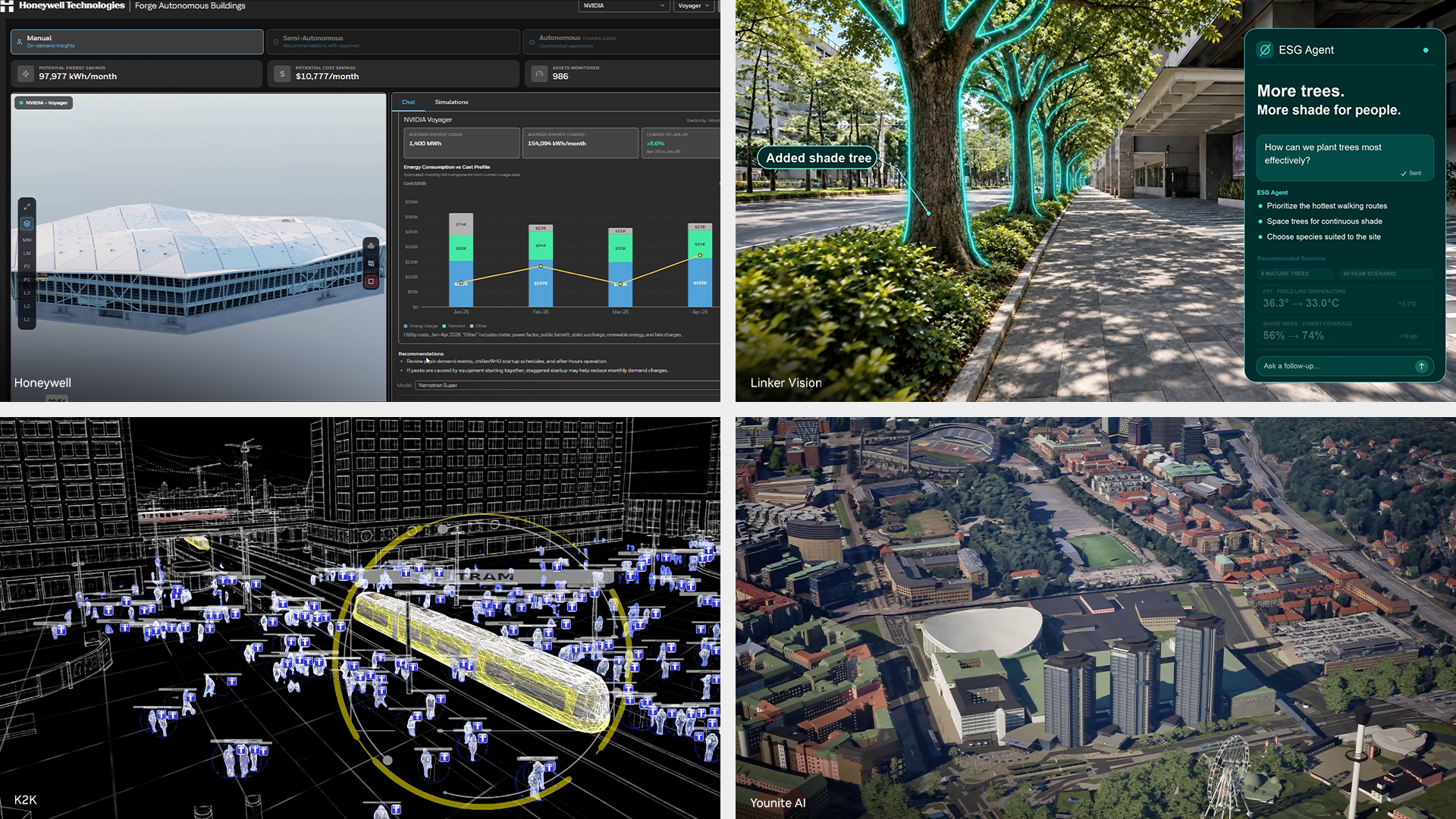
Software partners including ABA Technology, Akila, Galene AI, Honeywell Technologies, K2K, Linker Vision, Milestone, Onetera, ThinkDeep and Younite are using NVIDIA physical and agentic AI to develop solutions for city operations and public services.
Video courtesy of Linker Vision.
NVIDIA Cosmos open models and the NVIDIA Metropolis Blueprint for video search and summarization (VSS) help agents interpret video and identify conditions, such as traffic congestion, equipment condition, underused spaces and safety hazards, that need attention. NVIDIA Nemotron open models enable developers to build agents that reason over information, respond in natural language and deploy digital twins with NVIDIA Omniverse libraries.
Projects span Belgium, Finland, France, Italy, the Netherlands, Poland, Sweden, the U.K. and elsewhere.
In the U.K., the Liverpool City Region, K2K is exploring how to build AI factories using NVIDIA accelerated computing, Cosmos and the VSS blueprint that can support urban planning and public services — testing applications for mobility and safety. The Island of Jersey is working with K2K to strengthen decision-making, mobility and urban planning while advancing clean energy and public services. Innovation City Belfast is exploring a pilot with K2K focused on smart mobility, transport systems, citizen safety and event and response management.
Video courtesy of K2K.
In France, the Department of Côte-d’Or, Akila and ThinkDeep built operations agents that combine sensor, infrastructure and historical data in a sovereign digital twin using NVIDIA Nemotron, Omniverse and accelerated computing, with Cosmos adoption planned for video data. Across more than 500 public buildings, the agents support energy, compliance, safety and climate resilience, and cut document search time from weeks to minutes and reduce total operating costs by 10%, targeting 30% at scale.
Video courtesy of Akila.
In addition, Port Sud de France in Sète is working with ThinkDeep’s agentic platform that uses Cosmos and Nemotron to analyze cargo and safety data, coordinate operations and guide secure handling of hazardous materials.
In Italy’s Milan region, Galene.AI, Dell Technologies and TD Synnex are deploying an NVIDIA-powered, locally operated AI factory, starting with Cinisello Balsamo and planning expansion to four additional municipalities. Services include real-time translation, citizen chatbots and assistance with procurement and funding. These applications aim to simplify administrative work and help people get access to municipal data in seconds versus hours, while keeping local governance of data.
At Belgium’s Port of Antwerp-Bruges, Milestone and Dell Technologies are testing how agentic vision AI technologies, using NVIDIA Cosmos and the VSS blueprint, could support complex use cases such as oil-spill warnings by training models with synthetic data to prepare for incidents where real-world data is scarce.
In the Nordics, Younite is developing a digital twin experience with NVIDIA Omniverse libraries for Gothenburg in Sweden as a part of the EU’s Citiverse initiative, focused on helping cities simulate changes and improve accessibility by providing event entrance previews, seating and crowd conditions before arrival.
These cities point toward a broader ambition: adapting agentic applications to local needs and extending them across departments and neighboring municipalities and countries such as Poland’s city of Wroclaw.
Elsewhere in the region, Honeywell Technologies is deploying Forge Cognition, powered by NVIDIA Nemotron, Cosmos, Omniverse and the VSS blueprint, at the Dubai Fairmont Hotel to connect AI agents with building systems and improve reliability, energy efficiency and operations.
Video courtesy of Honeywell Technologies.
Building the AI Infrastructure for European Cities
For European cities, scaling from pilots to everyday operations requires infrastructure that can process local data, customize models and run AI agents.
System builders and infrastructure partners including Cisco, Dell Technologies, HPE, Lenovo and Supermicro are packaging NVIDIA accelerated computing, networking and storage into locally operated AI factories. These systems let cities customize and run intelligent applications locally while retaining control of their data, models and operations.
Nebius and Net Zero Compute are part of the broader ecosystem building AI factories designed to accelerate deployment and reduce costs for agentic services. EY and Accenture provide the integration and operational expertise to connect applications with city systems. Their work helps cities build repeatable deployment blueprints that they can adapt across departments and expand as local needs grow.
Learn how NVIDIA and its ecosystem are bringing physical AI, agentic AI and local AI factories to cities worldwide at Smart City Expo World Congress, running Nov. 3-5 in Barcelona.
Learn how Google DeepMind and GovTech Singapore uses lightweight on-device Gemma models to intercept conversational scams in private chats with zero cloud data egress.
Max Hodak, the former president and co-founder of Neuralink, detailed onstage at TechCrunch Disrupt how his company's work with PRIMA is part of its path toward a novel brain-computer interface (BCI).
Cerebras CEO Andrew Feldman predicts a future where personal AI assistants become as commonplace as household appliances, running partly on local devices and partly in the cloud.
Cerebras CEO Andrew Feldman has a message for AI leaders spreading doomsday warnings: Maybe stop talking? At TechCrunch Disrupt, he argued that the industry's focus on AI's risks is drowning out its potential benefits.
Topgolf’s VMware costs were going to increase by 400 percent under Broadcom. To avoid that cost, the sports entertainment company moved 12,000 virtual machines (VMs) to VergeIO’s VergeOS and has saved over $11 million so far.
Before migrating, Topgolf’s VMware connection “ran very deep,” Scott Forehand, Topgolf’s global infrastructure manager, told Ars Technica.
Topgolf has over 100 locations worldwide featuring interactive golf games with real-time shot tracking and digital analytics. The company used vSphere and ESXi for decades and started using VxRail, the hyperconverged infrastructure (HCI) platform that VMware co-engineered with Dell, in 2017. Topgolf employees previously participated in numerous VMware customer councils and have been interviewed for books on how Topgolf used vSphere and Horizon (now Omnissa Horizon), per Forehand, who is a leader of the Dallas/Ft. Worth VMware User Group.
SUMMARYMIT researchers published a PNAS study on Oct. 9 showing that an artificial neural network can organize itself and build its own learning machinery from simple rules. Starting from randomly connected units, the system learned to recognize patterns and classify images at a level similar to networks trained with gradient descent and backpropagation. The work aims to better explain how brains learn and could inform more biologically plausible machine learning systems.
Image: iStock
news.mit.edu
McGovern Institute researchers show that it's possible for an artificial neural network to build its own learning machinery.
As artificial intelligence becomes more and more powerful, its ability to handle human-like tasks is undeniable. Artificial neural networks can learn to recognize images, use language, or write computer code. Like the brain’s circuits, they reorganize themselves as they learn, adjusting the strengths of their connections to improve their performance.
The question for many neuroscientists is: What can these machine systems teach them about how the brain learns? And what kinds of models are likely to be the most informative?
In a paper published Oct. 9 in the journal PNAS, scientists at MIT’s McGovern Institute for Brain Research and K. Lisa Yang Integrative Computational Neuroscience (ICoN) Center argue that a crucial metric for the biological plausibility of an artificial neural network’s approach to learning is the network’s ability to organize itself, without the guiding hand of a developer. They show that it is possible for an artificial neural network to build its own learning machinery. With some simple instructions about how and when connections should change, a group of randomly connected units can reshape itself into an effective information-processing network, learning from the data it is trained on.
Biological learning
“Current AI technology is working very well, but it doesn’t necessarily use a learning algorithm that is used by the brain,” says Qianli Liao, a K. Lisa Yang ICoN Center Postdoctoral Fellow in the labs of MIT professors and McGovern Institure members Tomaso Poggio and Mark Harnett, and co-first author of the PNAS paper with MIT Research Scientist Liu Ziyin and graduate student Yulu Gan. Liao explains that engineers design the rules about how connections change as an artificial neural network processes training data and receives feedback about its mistakes.
When it comes to training AI to do its job, the approach is powerful. But Liao and his colleagues caution that networks designed in this way may not offer much insight into biological learning. “The brain doesn't have an external designer or architect,” Liao says. “The brain has to organize itself. And we need to know how simple rules are going to make the brain organize.”
The rules that reshape neural connections as an animal learns may be different in different parts of the brain, or they may change as the brain becomes more mature. Neuroscientists are working to understand how those rules work and how they might be disrupted by aging or disease — a vital step toward developing new therapies and prevention strategies. Liao points to the development of brain-computer interfaces, which aim to restore communication when the brain’s language abilities are lost or let paralyzed patients control neuroprosthetic limbs, as one potential application.
“None of these can work without knowing the rules behind neuron-neuron interactions,” he says. “That’s not achievable by just designing a circuit that works very well.” An artificial neural network’s value to neuroscience should instead be judged by the extent to which it can organize itself — not just its connections, but also the machinery that adjusts those connections.
Self-organized artificial learning
Working with Poggio and Hartnett, Liao, Ziyin, and Gan set out to develop and validate a self-organizing computational network capable of learning. Liao explained that the network’s structure begins with multiple layers of randomly interconnected neuron-like units. Within each layer, every neuron-like component is subject to the same rules about how connections should be adjusted. “They just interact with each other using that rule, and they develop some type of behavior,” he says.
The team’s network implements the kind of simple rules thought to rewire brain circuits as humans and other animals learn from their experiences. In both the brain and the machine network, for example, “neurons that fire together wire together.” In other words, when two connected neurons are activated at the same time, the connection between them strengthens.
The team showed that a self-organizing network governed by rules like these can learn to recognize patterns and classify images. They explain that in their model, learning is enabled by self-assembling motifs that emerge according to simple rules, then serve as building blocks for functional circuits. As their network learned, these motifs reorganized themselves using an optimization strategy similar to the approach built into most modern machine learning systems, called gradient descent, in which connections are gradually adjusted in response to errors in order to improve performance.
Most modern AI implements gradient descent through some form of the back-propagation algorithm, which neuroscientists say is unlikely to be used by the brain. The team compared its self-organizing network to networks designed to learn in this way and found that it performed at a similar level.
Connecting brains and machines
Poggio says finding a biological parallel to back-propagation could trigger significant progress in both AI and neuroscience.
“If the synaptic motifs we propose are, in fact, used by the brain to do what backpropagation does for artificial neural networks, then we will have a strong connection at the level of fundamental mechanisms between artificial and natural networks — between machines and brains,” he says.
Liao says a self-organizing network does not necessarily learn the same way the brain does — but it’s a critical starting point for biological plausibility.
“Self-organization is the first high-level framework,” he says. “Once we are good with self-organization as a measure, then we can talk about next thing.”
While the group’s main objective is better understanding the brain, Liao says that knowledge could ultimately improve machine learning systems, too, enabling engineers to develop networks that perform better or in more human-like ways.
CANADA - 2025/07/20: In this photo illustration, the Shopify logo is seen displayed on a smartphone screen. (Photo Illustration by Thomas Fuller/SOPA Images/LightRocket via Getty Images)
More AI agents will soon be able to browse and purchase from Shopify listings, marking an expansion of the company's agentic commerce ambitions.
Shopify announced Tuesday it will let shoppers configure their AI agents to purchase products on their behalf, giving more agents access to over a billion listings in Shopify's catalog. (The catalog consists of both items on and off Shopify storefronts.) In September, Shopify announced it was partnering with Meta to allow its Muse agent to browse and purchase items on a human's behalf; now, shoppers can use any agent without a partnership integration.
Retro gaming is going through a wild time at the moment, thanks to decompilations and recompilations that are letting gamers port classic titles to new devices, or merge code from two different games into a single new experience. Microsoft has witnessed skateboarding being modded into Call of Duty and Halo being played in a web browser, and the company is now officially embracing the chaos of this new AI-powered era of game modding.
Microsoft is putting together a new Xbox Labs group to explore the rapid emergence of these mods, many of which use AI models to help modders remix games in ways we've rarely seen before. Xbox Labs will be a "sm …
Rivian CEO RJ Scaringe's startup Mind Robotics announced the appointment of Doug Field as president in a major coup for the CEO's secretive robotics project.
Field was a VP of special projects at Apple, where he was the de facto head of the company's ultimately unsuccessful Project Titan effort to make an autonomous electric car. He had a previous stint at Apple as VP of Mac hardware engineering, but he left the company in 2013 to become Tesla's chief vehicle engineer, where he helped oversee the Model 3 sedan. He left Tesla in 2018 and rejoined Apple. In 2021, Field was hired by Ford to run the automaker's electric vehicle and software di …
University of Michigan spinout Laplace Intelligence uses AI agents and interactive simulation to stress-test robots and self-driving vehicles before deployment. The profitable startup is competing in Startup Battlefield at TechCrunch Disrupt, October 13-15 in San Francisco.
The problem with giving everyone in a company access to AI tools is that people will use them in unexpected ways. And that fact is steadily seeding fears that companies now have new, gaping security holes in their systems or, at least, will soon.
Facebook's new "Your Algorithm" feature will let you directly add and manage topics you want to see in your feed and Facebook Reels. Meta says your recommendations "respond right away" after you make updates using the new feature by hitting "interested" or "not interested" for different topics. Your Algorithm previously launched on Instagram earlier this year, and Meta also launched a similar "Dear Algo" feature on Threads.
Facebook users will be able to access Your Algorithm or select "interested" or "not interested" from the three dots menu on individual posts. The "interested" and "not interested" buttons may also appear under posts, an …
The Google Play Store is getting a big update for cars with Google built-in. On Tuesday, the company announced that the Play Store's layout will now automatically adapt to the size and layout of your car's screen while making it easier to find and download new apps.
The update, which is rolling out in the coming weeks, will put featured apps on the Play Store's homepage and allow you to download them with a single tap. It also comes with what Google says is a "streamlined navigation" menu that puts "Apps," "Games," "Search," and "More" options on the left side of your screen (or on the top if your car's screen has a vertical orientation).
The next time you vibe-code a custom app with Google's AI Studio, you won't have to connect your phone to a computer to install it. On Tuesday, Google announced a new feature in the US that will allow you to launch personal apps directly through the Play Store.
Google first launched the ability to vibe-code personal Android apps in May. Even though you can now launch your custom apps in Google Play, the company notes it will continue to keep them "secure, private, and separate from the public store catalog." You can also launch them using a standard Google account, and the company will soon add the ability to share your app with a select gr …
Google is making it easier to build and use personal Android apps created with AI, without having to make them available to everyone on the Play Store.
Satlyt wants to be the Android of orbital computing, offering open software that works on many companies' satellites, versus SpaceX's closed, all-in-one iPhone-style approach.
SUMMARYApple introduced HomeView, a $299 7-inch smart display for the home that combines Siri AI, FaceTime, customizable widgets, and Apple Home controls in a countertop or wall-mounted design. The device also functions as a Matter controller and Thread Border Router, supports up to six facial-recognition profiles, and can use personal context from messages, calendars, and email when paired with an Apple Intelligence-capable iPhone. It launches November 13th in eight countries alongside new Apple Home cameras, thermostats, and a door lock.
Apple has unveiled the $299 HomeView, a 7-inch smart display that combines Siri AI, FaceTime, customizable widgets, and Apple Home controls in a countertop or wall-mounted design. It also acts as a Matter controller and Thread Border Router, supports up to six facial-recognition profiles, and can use personal context from messages, calendars, and email when paired with a nearby Apple Intelligence-capable iPhone. The Verge reports: The device's square shape makes it feel less imposing than larger smart displays like Google's Nest Hub Max or Amazon's Echo Show 11, and I can see it fitting nicely on my kitchen counter -- though it might be a hair too big for my bedside table. The HomeView is the centerpiece of Apple's new push into the home. It costs $299 and launches alongside a new collection of cameras, thermostats, and a door lock designed for Apple Home.
As a smart home hub, Matter controller, and Thread Border Router, the HomeView can orchestrate these and other Apple Home and Matter smart home devices. It's available in eight countries at launch: the US, UK, Canada, Australia, New Zealand, Singapore, South Africa, and India. Pre-orders are open now, with devices shipping November 13th.
After months sitting on the sidelines of the frontier AI race, Google has finally launched its long-awaited Gemini 4 Argon model, claiming it can compete with the best the industry has to offer.
Google says Argon delivers "frontier reasoning and improved performance across complex workflows," while cutting down on hedging, repetition, and the cliches that continue to plague AI chatbots. The company claims Argon outperforms rival models like GPT-6 Astra, Claude Fable 5.1, and Claude Opus 5.5 across a range of benchmarks, including coding, cybersecurity, science, finance, and law.
Google says it's already putting Argon to use internally, s …
Epic Games plans to use AI to generate code and art for an unannounced Disney game, which is now delayed from its original March release window, according to a report from Bloomberg. The project's developers have been given an "AI-first" mandate directing them to use tools like Anthropic's Claude more to finish the game.
According to Bloomberg, one of the game's directors said in a message to staff, "No more hand-written code." Staff were also told that all of the game's art will be "generated with full AI workflows." In a statement given to Bloomberg, Epic Games spokesperson Jake Jones said the company is "embracing AI-accelerated develop …
SUMMARYMicrosoft unveiled the Azure Maia 300 AI chip at the OCP Global Summit 2026 in San Jose, expanding its in-house silicon lineup to reduce dependence on Nvidia and AMD. The company said Maia 300 will join Maia 100 and Maia 200 in multigigawatt deployments beginning next year and become the primary AI inference system for Microsoft products and services. Microsoft claimed the chip delivers 40% more tokens per megawatt than leading GPU-based systems, while Maia 200 already powers workloads for Microsoft 365 Copilot, Teams, and OpenAI models.
An anonymous reader quotes a report from Yahoo Finance: Microsoft has debuted its latest AI chip, the Azure Maia 300, as it looks to reduce its reliance on third-party processors from the likes of Nvidia and AMD. Unveiled at the OCP Global Summit 2026 in San Jose on Monday, the Maia 300 will join Microsoft's Maia 200 and Maia 100 chips as part of what the company said will be multigigawatt deployments beginning next year. The Windows maker said that will make its Maia chips the "primary AI inference system for Microsoft products and services."
The company said Maia 300 provides 40% more tokens per megawatt than "leading GPU-based systems," a clear swipe at Nvidia, and that a 96-chip rack offers seven times the rack-scale token throughput of Microsoft's Maia 200. [...] The Maia 200 chip currently powers its Microsoft production workloads, including Microsoft 365 Copilot, as well as OpenAI models, Microsoft's MAI models, and open-source models. That provides 1.7 times more tokens per watt for AI capabilities in Microsoft's Teams, Copilot, and Cowork software versus other GPU-based systems, the company said.
The HomeView is a smart speaker with a touchscreen display. It’s available in silver, starlight, rose pink, and space gray. | Image: Apple
It's finally here: Apple's long-rumored smart display, the Apple HomeView, has arrived. I got a first look at the device in New York City this week, and it's gorgeous. The HomeView puts a small, vibrant screen atop a speaker base for taking video calls, beautifully displaying photos, and providing information at a glance with Apple's Siri AI voice assistant. The device's square shape makes it feel less imposing than larger smart displays like Google's Nest Hub Max or Amazon's Echo Show 11, and I can see it fitting nicely on my kitchen counter - though it might be a hair too big for my bedside table.
American Express is introducing a new framework designed to ensure AI agents only make purchases their users have authorized, potentially preventing costly mistakes and disputes as AI-powered shopping grows.
SUMMARYNVIDIA announced RTX Spark laptops will launch on Oct. 16 with a new superchip aimed at creators, developers, and gamers, combining high-end graphics, local AI, and large unified memory in a thin-and-light PC. The company and partners are releasing updated apps, models, and developer tools, including optimized versions of Adobe Photoshop and Premiere, new Broadcast features, GitHub Copilot support, and the open-source Nemotron 3.5 Bolt 74B model for local AI agents. RTX Spark also adds expanded gaming support, DLSS 5, and new workflow tools for Blender, ComfyUI, and RTX Remix.
blogs.nvidia.com
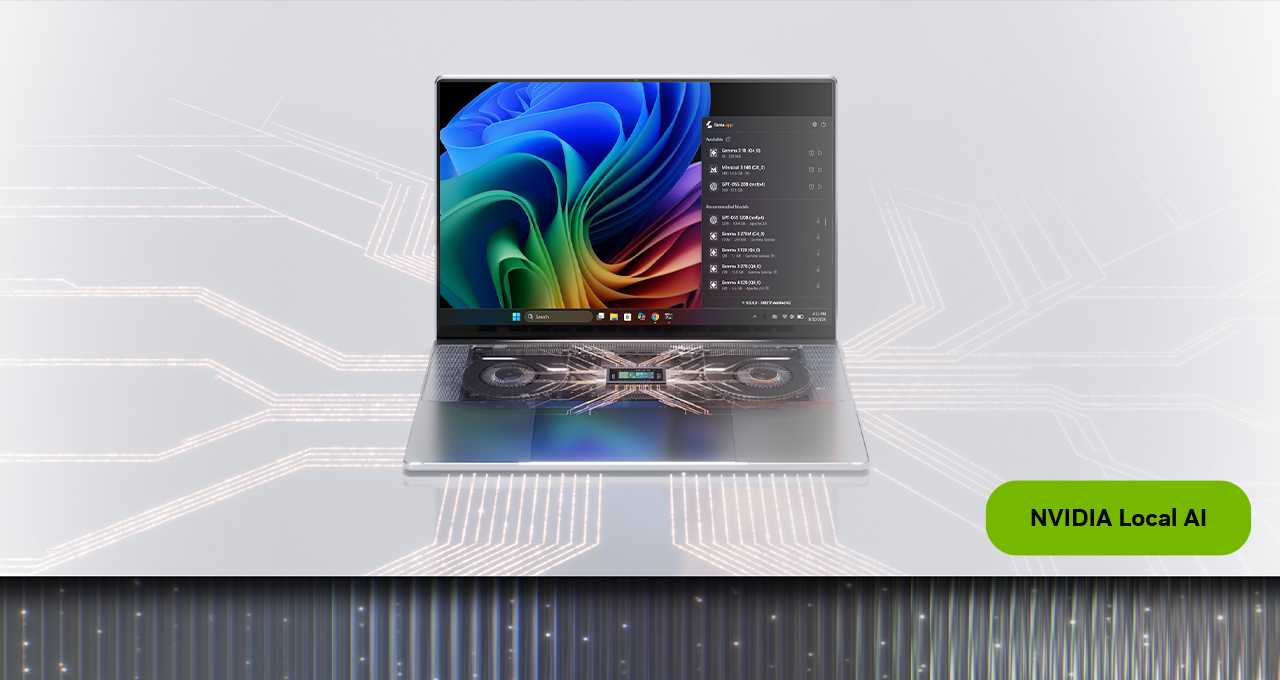
NVIDIA RTX Spark is a new beginning for the PC — a reinvention combining the capabilities of a gaming PC, a creative studio and a personal AI supercomputer into a single superchip. With up to 128GB of unified memory and 1 petaflop of AI compute, RTX Spark delivers the full stack of NVIDIA RTX and CUDA technologies for creators, developers and gamers, while unlocking a new paradigm in personal computing via powerful local AI agents.
New and upcoming RTX Spark updates — among the thousands of apps, games and models available at launch — include:
New agent features, models and tools that enhance local agents on RTX Spark:
Updates to top agent apps including GitHub Copilot, Hermes, OpenClaw, Perplexity, Pi and WorkBuddy streamline setup on RTX Spark, improve security with OpenShell and Microsoft Execution Containers (MXC), and enable hybrid local and cloud AI routing.
The NVIDIA Nemotron 3.5 Bolt 74B model, purpose-built for agentic AI on RTX Spark, releases on Thursday, Oct. 15.
NVIDIA PAIR moves out of beta and adds llama.cpp support.
Top creative apps optimized for RTX Spark:
Up to 2x performance is coming soon to Adobe’s top apps. NVIDIA and Adobe have collaborated to rearchitect Photoshop for GPU-accelerated compositing and Premiere for playback, rendering, effects and more.
The NVIDIA Broadcast 2.3 release brings new Video Super Resolution, Video Frame Generation, offline file processing and agent Model Context Protocol (MCP) controls to the app.
NVIDIA RTX Video Frame Generation and high dynamic range (HDR) capabilities are available now in ComfyUI to accelerate AI generative video workflows.
NVIDIA DLSS Ray Reconstruction will be available in Blender 5.3 in November to improve interactivity in the viewport.
Developer tools are now ready for RTX Spark:
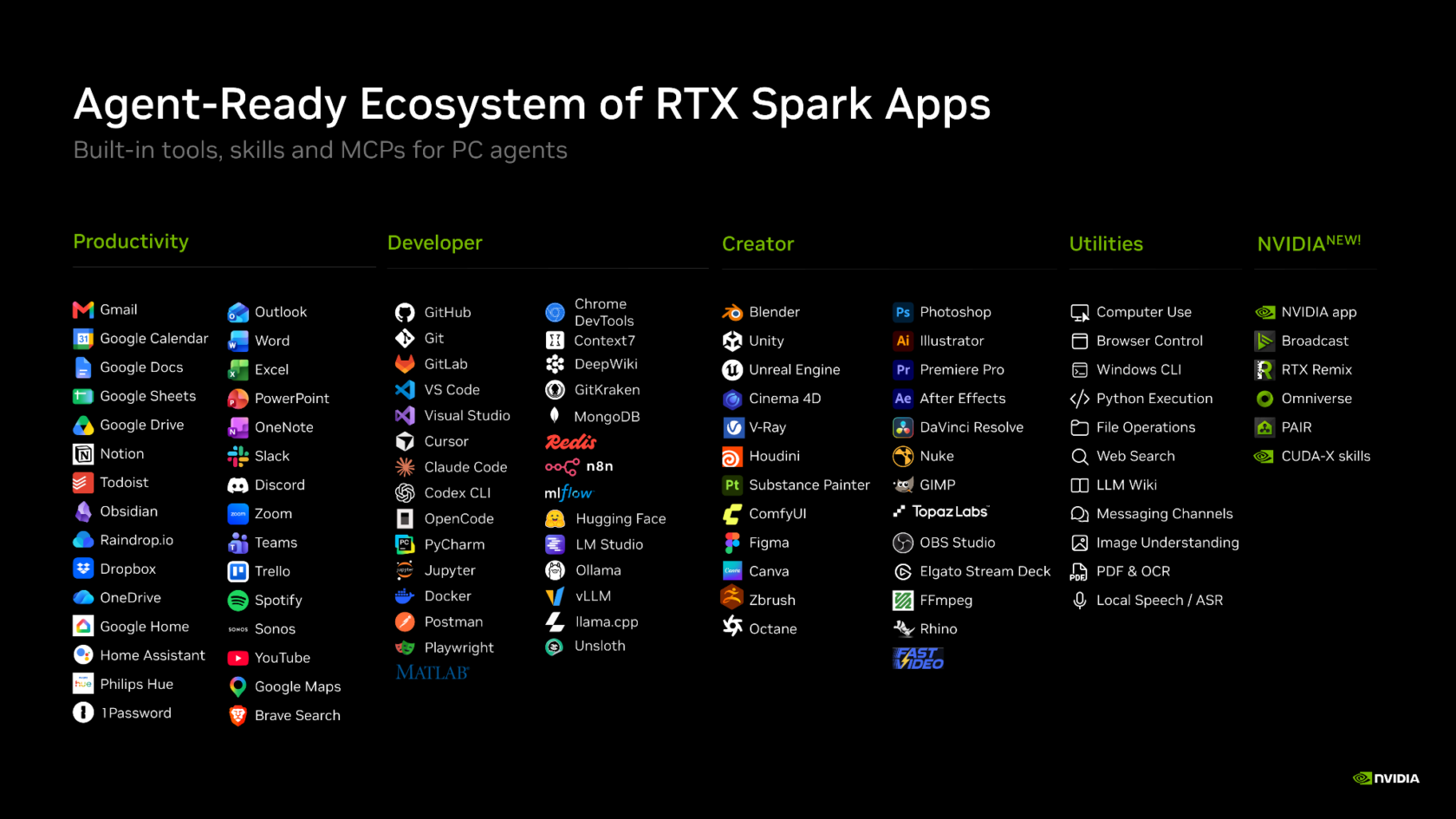
Top developer frameworks are now available for RTX Spark, including PyTorch, Python and CUDA, as well as all CUDA libraries.
GitHub Copilot, Pi and other coding agents are now optimized for RTX Spark.
Llama.cpp adds support for decision models, and releases a Windows app.
Hundreds of top games and anti-cheat are supported on RTX Spark, plus:
A 2x faster DLSS 5 AI model arrives Friday, Oct. 16, and a new Performance Mode for DLSS Frame Generation is available today via the NVIDIA App beta.
Nemotron 3.5 Bolt E4B 4GB, the third-generation small language model (SLM) for NVIDIA ACE AI game characters, releases Friday, Oct. 23.
The latest RTX Remix update, including DLSS 5 support, releases on Friday, Oct. 23.
Advancing Local AI Agents With New Apps, Models and Tools
AI is changing the way people interact with PCs. Agent popularity skyrocketed this year, with projects such as OpenClaw and Hermes topping popularity charts on GitHub. Local large language models (LLMs) surpassed the intelligence threshold to power agents, with models like Qwen 3.8-Flash-Next catching up to frontier cloud models released just a few months ago. As a result, local LLM downloads are already 5x higher than all of last year.
From models to agent harnesses to security to tools, NVIDIA is partnering closely with the local AI ecosystem to make RTX Spark the ideal hardware to run local agents.
Local AI Agents Made Easy On RTX Spark
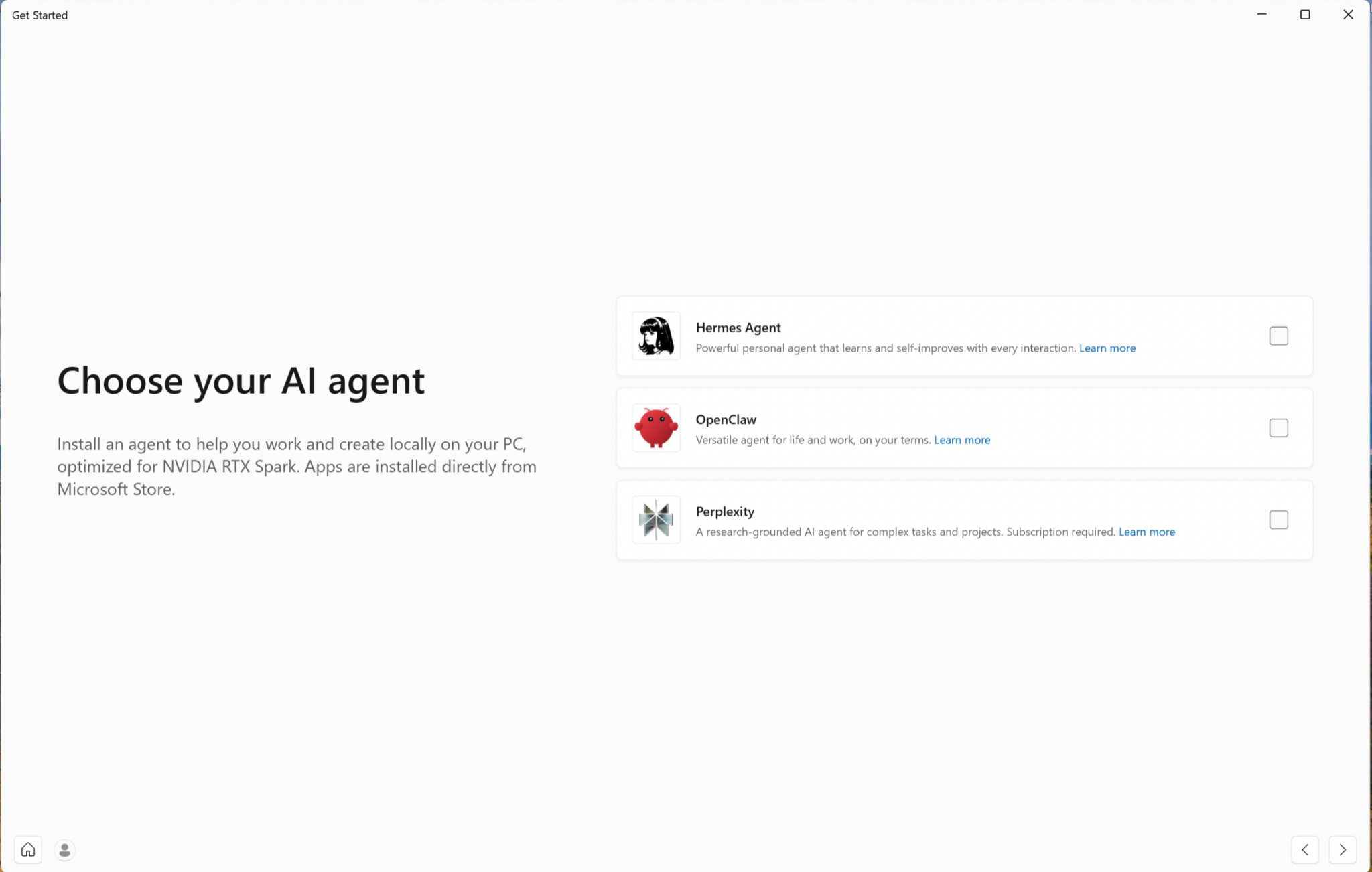
From the first boot of RTX Spark, users will be greeted with a “Getting Started” screen to choose and install their agent app.
These agents will come with new, secure sandboxing technology thanks to NVIDIA OpenShell and MXC. MXC delivers operating system-level security, while OpenShell makes it simpler for agents to adopt MXC and adds advanced capabilities such as credential protection and security monitoring. Hermes Agent will integrate granular OpenShell controls and MXC by the end of the month. OpenClaw and GitHub Copilot now support MXC.
After installing an agent, setting up local AI is also now seamless in GitHub Copilot, Hermes Agent, OpenClaw, Perplexity, Pi and WorkBuddy. The apps will recommend an optimized local model and settings configuration for RTX Spark, and set it all up for users in a few clicks.
Many users want the best of both worlds — local models for free iteration, and cloud models for frontier intelligence. NVIDIA Switchyard, an open source model router library, enables agents to intelligently route queries between local and cloud LLMs, allowing the user to minimize cloud usage but still obtain similar results to just running on cloud. Hermes will be adding Switchyard later in October, and other agents like Perplexity Computer and GitHub Copilot have integrated their own routing solutions.
Software providers have made it simple for agents to connect to top Windows apps, with easy-to-use MCP libraries and command line interfaces (CLIs). NVIDIA has also now made available MCPs for its applications, including NVIDIA App, Broadcast, PAIR, Omniverse, RTX Remix and a large library of CUDA-X Skills.
NVIDIA is also releasing AI playbooks for RTX Spark, available on Friday, Oct 16. Users can set up their first agent, build an AI chief of staff, configure their system for development or design a creative assistant.
Meet Nemotron 3.5 Bolt 74B: Built for Local Agents on RTX Spark
NVIDIA Nemotron 3.5 Bolt 74B-A9B 24GB, available Thursday, Oct. 15, is a new LLM purpose-built for running local agents on RTX Spark.
This model is a 74B parameter, 9B-active-parameter mixture-of-experts (MoE) model, packed into 24GB using 2-bit quantization with advanced quantization-aware training techniques to retain quality. It aims to achieve the optimal balance between speed and intelligence, being faster than most popular dense models while smarter than most popular MoE models with a similar memory footprint.
Users will be able to run Nemotron 3.5 Bolt 74B at launch through llama.cpp, vLLM, Ollama, Unsloth and LM Studio. It will also be directly accessible via agents such as Hermes and OpenClaw.
Like other Nemotron models, Bolt 74B is fully open source — including training data, weights and recipes — so developers can fine-tune and customize their own agents.
The Perfect PAIR
Local AI doesn’t have to run on just one PC. NVIDIA PAIR, a personal AI router, is officially moving out of beta today, making it easier to tap into the total AI compute of compatible PCs on a local network. The free, open source software tool automatically discovers and connects devices, installs AI models and inference engines, and distributes AI workloads across available systems.
The official release adds llama.cpp support, direct model downloads from Hugging Face, customizable inference engine settings and RTX Spark support, along with a variety of inference and user experience improvements.
PAIR works on Windows, Linux and macOS. Developers can contribute to the open source project via Github — just one month after the initial PAIR release, the community has already contributed over 10 features and fixes to the release.
Sparking Creativity
RTX Spark brings over 130 accelerated apps, CUDA for fast video and image generation, and RTX technologies such as DLSS, NVENC and OptiX to advanced content creation workflows — all in a thin and light laptop with on-the-go performance.
Adobe Accelerates Creative Applications for RTX Spark
Adobe is optimizing its industry-leading creative applications, including Photoshop, Premiere and Substance 3D, for RTX Spark, delivering up to 2x faster AI, editing, color and effects across creative workflows.
In Photoshop, GPU-accelerated compositing makes complex image editing faster and more responsive, with improvements to the Remove Tool and effects such as Light Leaks. Premiere accelerates demanding video editing tasks, including playback, rendering, color grading and AI-powered features such as Enhance Speech and Object Mask. Meanwhile, Substance 3D Painter speeds up texture creation workflows, from baking high-resolution mesh maps to opening, saving and exporting large projects.
The updates will be rolling out in phases, with AI feature optimizations in Photoshop and Premiere now ready in beta, and with Adobe Substance 3D updates coming soon. Opt in to the beta to get access to the RTX Spark-optimized builds.
Latest NVIDIA Broadcast Brings New AI Effects to Live and Recorded Content
Available for download now, NVIDIA Broadcast 2.3 runs natively on RTX Spark, and adds new RTX Video Super Resolution and Frame Generation AI effects and Studio Voice profiles.
A new Offline File Processor lets creators apply Broadcast effects to prerecorded content, with many effects running at higher quality since there isn’t a need to maintain real-time performance. The update also introduces a new MCP server and skill that lets local AI agents adjust effects, change settings and process files directly through the Broadcast app.
RTX Video Brings Frame Generation and HDR to ComfyUI
ComfyUI is expanding its RTX Video tools with two new nodes: RTX Video Frame Generation and RTX Video HDR. It’s also providing the ability to export EXR files, giving creators more ways to enhance AI-generated video.
RTX Video Frame Generation increases video frame rates for smoother motion for GeForce RTX 40 Series GPUs and newer, while RTX Video HDR converts standard dynamic range (SDR) footage to HDR for greater flexibility in color grading. Combined with RTX Video Super Resolution, these tools enable creators to upscale, enhance and refine video within a single ComfyUI workflow.
For example, creators can combine LTX 2.5 with RTX Video Frame Generation and HDR to transform a 1080p, 30 frames-per-second (fps) SDR clip into a smoother 60 fps HDR video exported as EXR files ready for color grading.
Blender Adds DLSS 4.5 Ray Reconstruction
Blender has released a beta version of its popular 3D editor, adding compatibility for RTX Spark. Download Blender version 5.3 to get access.
Coming next month, Blender will also be adding support for DLSS Ray Reconstruction, allowing for real-time updates in the viewport so artists can navigate a scene while previewing it in real time.
Code, Text and Deploy From RTX Spark
Developers are moving from writing code to directing AI agents. This new development paradigm is requiring many to spread their work across their laptop, a cloud LLM and a cloud virtual machine, where they test and prototype.
RTX Spark enables developers to work on one machine, running all their workloads and libraries, testing and prototyping, and deploying. They can now do so directly in Windows with the new Windows Developer Config, which enhances the user experience for devs and installs all the top developer tools — or via Windows Subsystem for Linux, where they can get access to the same packages they’ll use to publish to the cloud.
Developer Tools Are RTX-Spark Ready
NVIDIA has partnered with Microsoft to ensure that developer tools are ready for RTX Spark. Alongside RTX Spark, the community is releasing:
The first PyTorch-CUDA build for Windows on Arm.
The first Python build that is native by default on Windows on Arm, with Python 3.15.
The first native Conda installer for Windows on Arm, with over 2,000 Conda packages.
97% of the top 15,000 Python wheels are ready, thanks to work with the ecosystem. NVIDIA will be working closely with the community to ready the remaining wheels.
Development is now mostly done by agents. NVIDIA Skills — an open source GitHub repository that teaches agents how to use NVIDIA CUDA-X tools and libraries — lets users develop apps that are accelerated on NVIDIA technologies, even without knowing anything about CUDA.
Coding Agents Are Ready for Local AI
In addition to GitHub Copilot — one of the most popular coding agents, used by millions worldwide — adding support for MXC, it’s updating its model router HydraFusion with support for local models. This enables developers to use their local hardware to reduce token consumption while tapping into frontier intelligence.
Microsoft is making coding models, such as MAI 1.1 Coding Flash, available locally, and adding llama.cpp as a backend to Windows ML — extending the supported models and enabling the latest NVIDIA performance optimizations.
Get started with GitHub Copilot running locally when RTX Spark launches.
Llama.cpp Adds Support for Decision Models, Releases a Windows App
Decision models are the latest breakthrough in AI development. They give AI agents a near-instant way to make decisions, without lengthy reasoning loops. They can choose what to do next, from classifying requests to selecting the next action, up to 200x faster than traditional agents. Decision models are now supported in llama.cpp and Unsloth on RTX Spark and GeForce RTX GPUs.
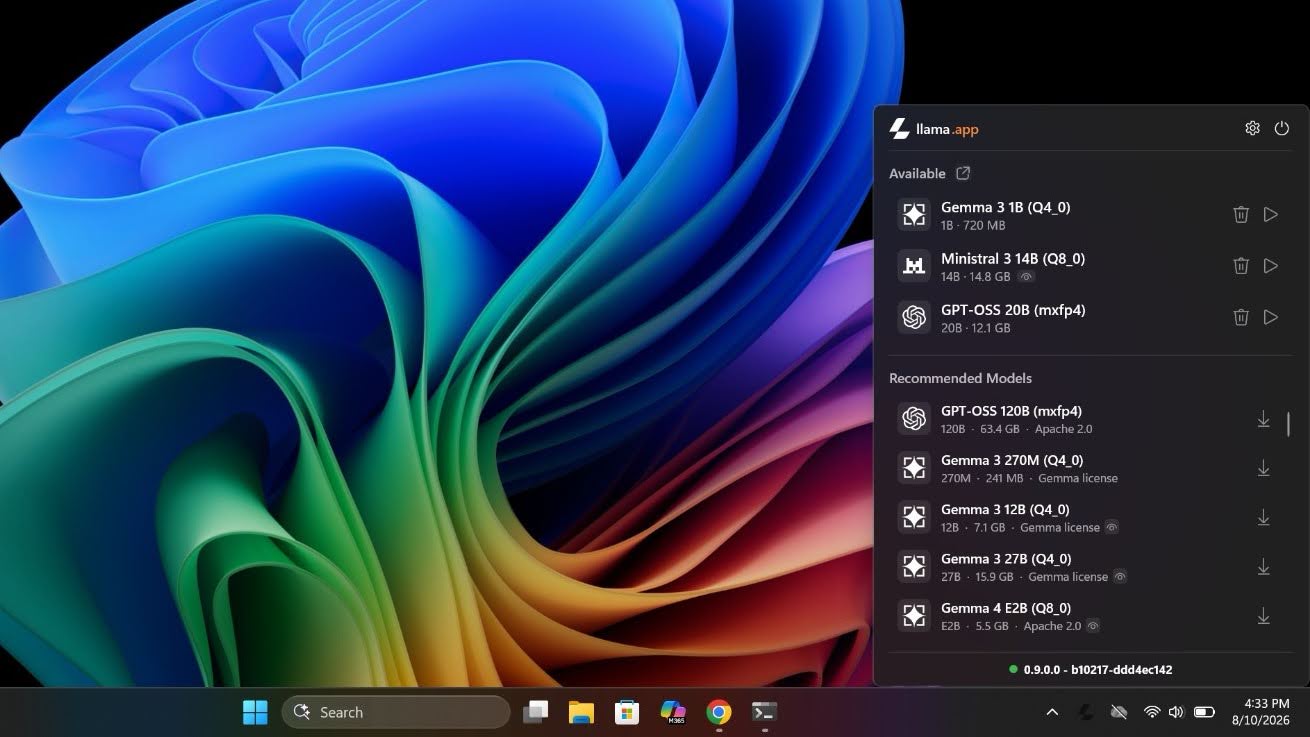
Llama.cpp is also releasing today Llama Windows, a Windows-native companion app for llama.cpp, enabling an easy-to-use user interface to download and run models locally, without having to go into the command line. This app, like llama.cpp, is optimized for RTX Spark. Learn more on the Hugging Face blog.
Llama Windows runs from the Windows 11 system tray, with local models and recommended models from the Hugging Face Hub one click away.
Game On: RTX Spark Launches With Hundreds of Top Games and DLSS 5
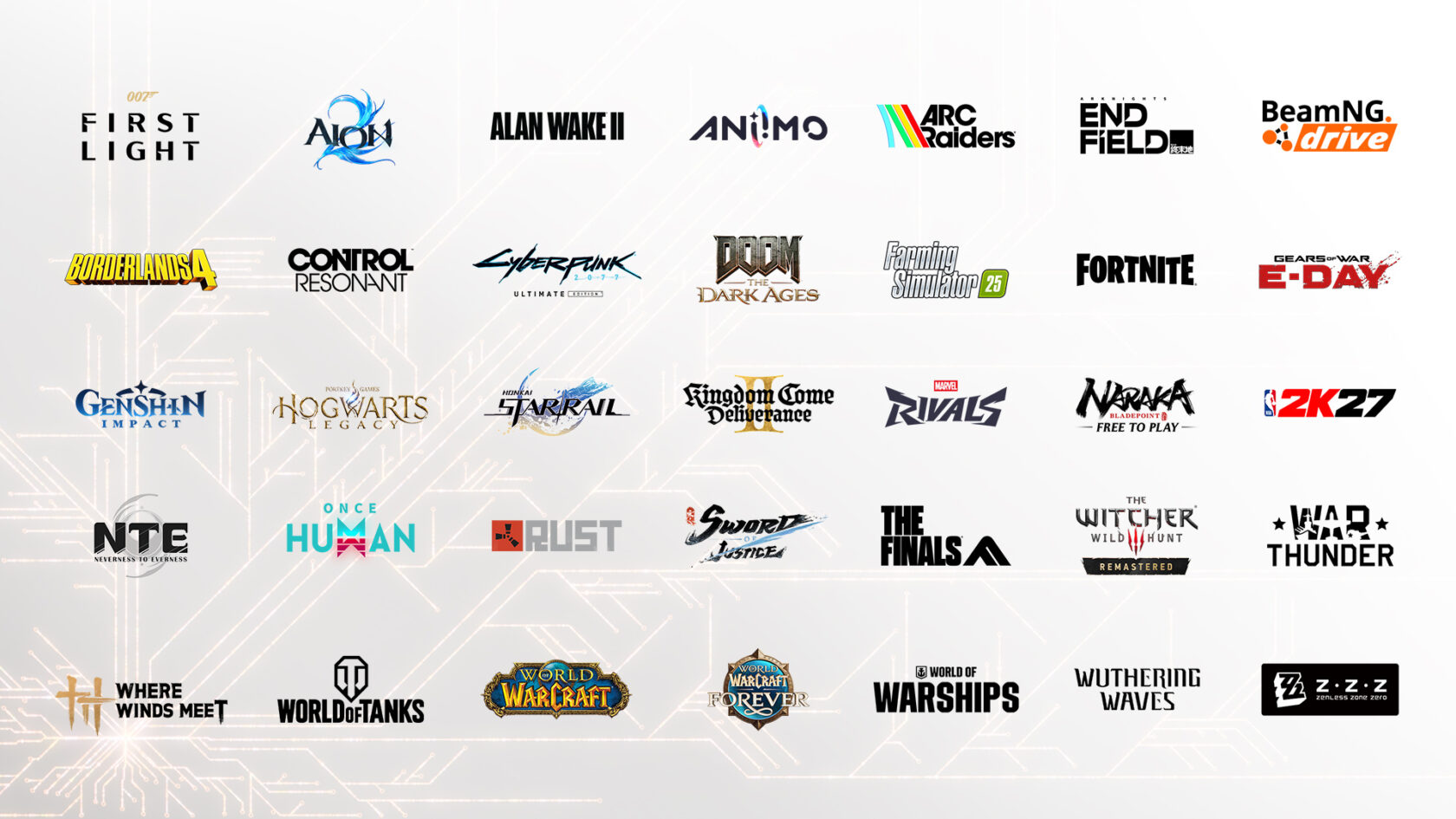
RTX Spark is ready for gaming, with hundreds of top titles available when laptops launch on Friday, Oct. 16, including CONTROL Resonant, Cyberpunk 2077, Fortnite, Gears of War: E-Day, Genshin Impact, Hogwarts Legacy, Honkai: Star Rail, Marvel Rivals, NARAKA: BLADEPOINT, NBA 2K27, World of Warcraft and many more.
NVIDIA has worked to bring the full stack of RTX technologies, including DLSS, Reflex, Remix, G-SYNC and ray tracing, to the new platform, along with collaborating with game developers to enable anti-cheat support for popular multiplayer games. Learn more about gaming on RTX Spark.
DLSS 5 Brings Neural Rendering to RTX Spark
NVIDIA DLSS 5 with 3D-Guided Neural Rendering is also coming to RTX Spark on launch day. The technology uses AI to enhance lighting and materials with lifelike detail, making game worlds and characters more realistic while preserving developers’ artistic vision. A new, 2x faster DLSS 5 AI model debuts in NBA 2K27 on Friday, Oct. 16, boosting frame rates by up to 1.4x. The faster model will also power DLSS 5 in Hogwarts Legacy starting Thursday, Nov. 5, and Where Winds Meet in late November.
DLSS 5 is also coming to NVIDIA RTX Remix on Friday, Oct. 23, so modders can add better materials, lighting and shadows to classic characters and environments, as shown from modder Sparkles/Kim2091 in her in-development project, Fallout 4 RTX.
Nemotron 3.5 Bolt E4B 4GB is the third-generation SLM for NVIDIA ACE, the suite of technologies for building in-game AI agents that deliver next-generation gaming experiences. The first-generation model was in a public beta earlier this year for PUBG, allowing players to team up with AI teammates, while the more efficient second-generation model previewed in Aniimo at Gamescom, turning standard creatures into voice-responsive companions.
Nemotron 3.5 Bolt E4B combines natural conversation with multi-turn tool use, instruction following and grounding in application state to power fast local voice and device assistants, interactive characters and embedded interfaces.
Designed for a low memory footprint and fast time to first token, this model enables responsive local experiences while leaving headroom for applications and other AI models. Its new conversational mode helps keep responses concise and speech-ready, and developers can turn reasoning on or off as needed.
Starting Friday, Oct. 23, test drive the third-generation Nemotron 3.5 Bolt E4B 4GB inside SkyrimNET, an AI nonplayable character (NPC) modding platform by MinLL for The Elder Scrolls V: Skyrim. SkyrimNET transforms every NPC into an unscripted, interactive character equipped with personal memory, voice and autonomy for dynamic conversations and context-aware quests generated on the fly.
Now compatible with RTX Spark, SkyrimNET supports both cloud and local inference across multiple models, with the latest Nemotron models delivering best-in-class performance for efficient and fast in-game interactions. Download the build on GitHub.
Accelerating Modding Workflows in RTX Remix
As AI agents continue to help modders make their favorite classic games compatible with the RTX Remix renderer, NVIDIA is streamlining asset updates with a major overhaul to its AI-powered texture generation workflow. Launching Friday, Oct. 23, as part of Remix 1.6, ComfyUI Version 2 replaces complex REST application programming interface (API) node connections with a dedicated AI tools layout directly in the sidebar.
This update allows modders and artists to generate physically based rendering materials natively inside RTX Remix with zero API setup required. A new batch processing feature makes it easy to scale beyond single-texture experimentation to full modding projects, while an intuitive presets system lets non-technical creators adjust key settings without touching the node graph.
SUMMARYNo Man’s Sky is coming to iPhone and iPad on October 28 for $19.99, with a free trial available before purchase. The mobile release includes years of content and system updates, runs on devices as old as the iPhone 11 and third-generation iPad Air, and brings the game’s procedurally generated galaxy exploration to iOS. Some features are limited, including planetary settlements on iPhone 15 Pro and later, and multiplayer is not supported on iOS.
No Man's Sky is coming to iPhone and iPad on October 28, more than a decade after its rocky launch and long-running redemption arc. The title will cost $19.99, but a free trial will let users try it out before purchasing. Ars Technica reports: It will run on devices as far back as the iPhone 11 and the third-generation iPad Air. No Man's Sky might not have the most cutting-edge AAA graphics (though they're still strong, and they've come a long way since launch via updates), but the game's uncommon method of generating galaxies of incomprehensible scale on device consistently for all players from a single-seed happening on a phone is remarkable for those of us who remember phones performing far behind consoles or desktop PCs.
This version of the game includes all of the content and systems updates to the game that have been added over the years -- the expansions that famously took the game from a rocky launch reception to a widely beloved redemption story. There are a couple of compromises, though, and it's similar to what we saw with No Man's Sky on the Nintendo Switch. Hello Games says the ability to build and explore player-made planetary settlements is limited to the iPhone 15 Pro and later, and multiplayer is not supported on any iOS device. "We are excited to see player feedback on iOS, and will support it appropriately based on how many folks are playing," the company says, leaving the door open to perhaps not supporting all future content updates if the player base isn't there to justify it.
SUMMARYResearchers created a strengthened ice-based material called BioPykrete by combining ice with cellulose nanocrystals and a custom binding protein, CBM3a-AFPIII. In small-scale tests, it was about 10 times stronger than regular ice and absorbed 70 times more energy before breaking. The team says further tuning could improve the composite for uses in packaging, construction, and other demanding environments, and the findings were published in Colloids and Surfaces B: Biointerfaces.
Researchers have created a strengthened "BioPykrete" by combining ice with cellulose nanocrystals and a custom protein that binds the plant-based crystals to the ice structure. In small-scale tests, the material was about 10 times stronger than regular ice and absorbed 70 times more energy before breaking. ScienceAlert reports: Instead of wood pulp's larger, disordered fibers, the researchers used cellulose nanocrystals here. Cellulose is the main structural material in plants, and in nanocrystal form, it can act as a microscopic strengthening agent for other materials, including ice -- essentially stopping cracks from spreading easily. The protein used here was called CBM3a-AFPIII, a combination of an antifreeze protein (AFP) and a carbohydrate-binding module (CBM). Its job was to act like glue, keeping the cellulose nanocrystals and ice bonded together.
It's a clever approach, and the researchers think that by tweaking their ingredients and methods, they might be able to improve their 'super ice' even further. "Optimizing solidification kinetics and freezing protocols, alongside developing diverse AFP-CBM variants, could yield even higher-strength composites," write the researchers. Besides further tests of the durability of the material, the researchers are also keen to take a closer look at how cracks propagate through BioPykrete, to confirm that the underlying strengthening mechanisms are what they think they are.
Further down the line, this approach could open up a whole new landscape for materials used in packaging, construction, and more: Using a custom protein to bring two unlikely compounds (ice and cellulose) together. "By bridging the gap between recombinant protein design and structural engineering, we have developed a high-performance material specifically engineered for the rigors of the world's most extreme environments," write the researchers. The findings have been published in the journal Colloids and Surfaces B: Biointerfaces.
SUMMARYFrench companies and institutions are deploying agentic AI systems across manufacturing, finance, public services, telecom, science, and robotics using NVIDIA infrastructure and open models. Bull is expanding European AI server production for NVIDIA systems, L’Oréal is using NVIDIA’s ALCHEMI Toolkit to speed cosmetic discovery, and Mirakl has used NVIDIA GPUs to onboard more than 70 million products. A satellite in Loft Orbital’s Altair-1 constellation has also reached orbit with NVIDIA Jetson modules for autonomous operations and Earth observation.
blogs.nvidia.com
Companies in France are deploying agentic computing across industries spanning space, financial services, the public sector and scientific research, demonstrating how the country’s ecosystem has moved from ambition to application.
France’s progress sits on deliberate groundwork.
The AI Action Summit in February 2025 and Choose France Summits in 2025 and 2026 anchored major compute commitments on French soil. What the ecosystem has built since then spans the full stack.
NVIDIA has been investing in France’s startup ecosystem, having previously invested in leading technology companies including Alice&Bob, Gradium and Scintil Photonics.
Across all of Europe, NVIDIA has committed nearly $10 billion to the technology ecosystem.
Today, NVIDIA announced new planned investments in Doctolib, Entalpic, Genesis AI and Pigment.
These startups are innovating to solve challenges across healthcare, materials discovery, physical AI and business planning.
Doctolib, a European healthcare technology company, builds agents that free up healthcare professionals to deliver better care, while providing patients with a digital health companion that improves access to care and supports more preventive, continuous medicine.
Entalpic, a Paris-based startup, accelerates the engineering of advanced materials at the atomic scale, with particular expertise in surfaces and interfaces for semiconductor manufacturing and next-generation electronics.
Genesis AI is a global robotics company developing general-purpose robots with frontier intelligence and capabilities through its foundation models, data collection systems, simulation infrastructure and robot hardware.
Pigment, a Paris-based enterprise software company, builds a planning platform that helps businesses forecast performance, model scenarios and make decisions across finance, sales, workforce and operations.
Sovereign AI Infrastructure
France-based companies are expanding agentic infrastructure on NVIDIA technology.
Bull is extending its European AI server production to NVIDIA Vera Rubin Ultra NVL72 systems, planned for 2028, with trays produced in Europe and rack integration at its Angers factory — inaugurated Friday, Oct. 2.
Altair-1, the first satellite in a $1 billion, 50-satellite constellation with on-board autonomous capabilities, launched this month and has successfully reached orbit. Integrated by Loft Orbital and built in Abu Dhabi by Orbitworks, a joint venture between Loft Orbital and Marlan Space, the satellite is flying NVIDIA Jetson AGX Orin edge modules, running Mistral’s models, for real-time Earth observation and autonomous operations in orbit.
Open Models
NVIDIA Nemotron open models are in production across French organizations that require sovereign, trustworthy data.
LINAGORA and Docaposte have secured the CANUT framework agreement, making Twake.ai, built on NVIDIA Nemotron, the sole referenced sovereign digital workplace for more than 2,500 French public organizations.
In financial services, SBS is launching a sovereign platform enabling banks to deploy governed generative and agentic services within their own environments, in collaboration with NVIDIA.
Last week, Mistral introduced under private preview Mistral Large 4 open model, with state-of-the-art, open weight performance in cyber defense, manufacturing, finance and multimodal tasks, and a solid foundation for customizing models across key industries.
Fondation Inria, with NVIDIA’s support, is launching a working group on open source advanced modeling and tool adoption, with findings to come in the spring of next year.
Agents at Work Across Industries
Across retail, public services, telecommunications and science, the pattern is consistent: open models and NVIDIA infrastructure are driving results in France.
L’Oréal is integrating NVIDIA ALCHEMI into its research workflows so scientists can explore formulation possibilities in silico and better help guide laboratory research. Combining computational predictions with hands-on experimentation can make the discovery process up to 100x faster than traditional methods and maximize the potential of the group’s proprietary active ingredients.
Mirakl has onboarded more than 70 million products with fine-tuned and open models running on NVIDIA GPUs and inference software, cutting seller catalog onboarding to under two hours.
Photoroom and Vestiaire Collective are demonstrating the measurable business impact of advanced visual modeling on marketplace performance.
Omi helps brands bring accurate products into AI-generated marketing visuals at scale, combining its approved 3D digital twins with open models optimized on NVIDIA for 4x faster inference.
In Côte-d’Or, ThinkDeep and Akila built a digital-twin agent — powered by NVIDIA Cosmos open world models, Nemotron and Omniverse libraries — managing nearly 5,800 kilometers of roads and buildings, cutting total operating costs by 10% and targeting 30% as deployment progresses.
Port Sud de France runs goods processing and port security on ThinkDeep’s DeepBrain platform powered by Nemotron and Cosmos.
Enchanted Tools, a robotics company headquartered in Paris, is deploying social robots to support patients in healthcare settings including pediatric cancer care.
In telecom, Bouygues Telecom and Prisme.ai have launched AI Studio V2, powered by NVIDIA full-stack infrastructure, to offer all of its employees the ability to build their own agents, securely and in a controlled environment
In quantum, Alice & Bob has integrated the NVIDIA NVQLink platform for its superconducting cat qubits, showing how GPUs can make quantum error correction more efficient, including for faster qubit modalities.
Quandela has also been using NVQLink to build an integration between a DGX Spark system and its photonic qubits — advancing QPU-GPU supercomputing and exploring hybrid quantum-classical applications.
Tune in to NVIDIA founder and CEO Jensen Huang’s GTC Berlin keynote on Wednesday, Oct. 21, at 11 a.m. CEST.
SUMMARYDeb Roy of MIT argues that AI-generated text in civic life must remain tied to accountable human authors, especially as realistic machine-written public comments make it harder to trust democratic feedback channels. In a Bulletin of the Atomic Scientists essay, he calls for “standing” and “answerability” in communication and describes design principles for tracing AI-assisted output back to people who can take responsibility. His Center for Constructive Communication is also building tools like VoiceTrace and running dialogue programs to support trustworthy group deliberation.
Credit: Jose-Luis Olivares, MIT; iStock
news.mit.edu
Deb Roy encourages accountability for all written text in the age of AI.
When government officials craft policies, there is often a comment period for public feedback. Lawmakers have long had to sort through fake feedback that is mass-produced in an effort to sway policy, but they’ve generally gotten used to detecting it. With, artificial intelligence, however, people can submit realistic-seeming comments, which are harder to dismiss as being fabrications with no person behind them. That’s just one way AI can be used to generate text and statements, in civic conversations, for which no one can be found to be answerable.
This issue, among others, has caught the attention of Deb Roy, professor of media arts and sciences at MIT and director of the MIT Center for Constructive Communication (CCC). In a new essay published in the Bulletin of the Atomic Scientists, titled, “Who stands behind the words?,” Roy calls for a renewed emphasis on responsibility in communication, asserting that even when AI is used to craft text, there needs to be accountability and “answerability.”
Building better group dialogues to produce more public trust is a core part of the work of CCC. The group, along with Cortico, the closely affiliated nonprofit Roy co-founded, has helped facilitate group discussions on important issues in many situations — including civic meetings, schools, deliberative assemblies, and private organizations — and used tech tools, including AI, to help find themes among comments, and more. But the center also designs this process so that participants can check and override the tech-based output at each key step. Ultimately, a person is responsible for every public comment. MIT News spoke to Roy about the essay and the work of the center.
Q: You’ve identified this problem about the lack of accountability behind words that are generated by AI. When did you really first notice this?
A: It came into focus when Chat-GPT [which is powered by a large language model, or LLM] launched. As for my own history with language models, my PhD work explored what we might now call PLMs — Puny Language Models — so I’m quite familiar with language models and have tracked the field’s rapid evolution. But Chat-GPT turned a corner. Two things changed at the same time: the depth of the model and its knowledge, and the way you could interact with it.
I became obsessed with trying to find the limits of what it could do. And I felt that no matter how hard I tried to stretch my arms around it, I couldn’t. I built my tenure case at MIT on language grounding — the idea that it’s not enough for an AI system to just process lots of words and other symbols. I believed that to understand what words mean, you actually need a physical body and life experiences as part of the process. So I revisited the philosophy-of-AI literature I had once been steeped in, which asks what fundamentally distinguishes the kind of system that large language models exemplify, in extraordinarily advanced form, from the kind of processing we humans engage in. I gave several presentations to my own graduate students trying to make the case that, even though AI seems so intelligent, it’s actually different in kind — and I could not convince them.
And I thought, I know the difference, but I’m having trouble convincing even myself of what it is. And that led me to ask, “Wait a minute: Is there someone or something that stands behind the words, a human responsible for what is being said?” That’s the thing this extraordinary new language machine doesn’t have.
Whether these systems genuinely understand language is actively debated. But even if you grant them all the comprehension you like, they still lack standing. The buck can’t stop at a thing, a software system, with nothing to lose.
Q: The Bulletin piece has these interesting examples of civic feedback forums where it looks like there are real people saying things, and instead you have a barrage of comments from AI. How did you find some of these other examples in society where things go off the rails in this way?
A: After the release of ChatGPT, I started hearing a concern from people inside government who review public comments on proposed rules: a suspicion that not all of the comments were written by humans.
My reaction was: That’s going to delegitimize this channel for public feedback. That was several years ago, but everyone now knows this is happening. Public comment is a pillar of democracy. You don’t just put a new rule in place. People need to have a voice and feel like they’ve been heard before a rule is imposed on them. If you skip that step, people don’t accept rules as legitimate. That’s why that process is baked into how America works. And that pillar just cracked, and by now, in my mind, it’s fallen over. Has anyone noticed? My sense is the people on the receiving end of these comments have quietly adjusted the weight they give to public comments. It was never perfect, but boy, now much of its value is being swept away.
I open my essay with this example: In 2017, the Federal Communications Commission received more than 22 million public comments on its proposal to repeal net neutrality rules, and the New York attorney general later found that nearly 18 million of them were fake. As I write in the essay, “That fraud was caught because it left fingerprints: templated text, duplicated phrasing.” But large language models erase the fingerprints. Now every comment can be fluent and different, and reviewers can no longer tell which ones express views that real people formed and stand behind.
If you have enough of the stuff that’s fake — words that no one with a stake actually stands behind — it desensitizes you to what’s real. That filters back to the public, and people realize: If I take the time to express myself, they’re not even listening any more.
Q: Could you say a little bit more about your point that we need people with “standing,” who will take “accountability” for all pieces of text, even when those bits of text are generated by AI?
A: In the legal system, standing is a formal idea: sometimes a case isn’t heard because the people bringing it don’t have standing. But informally we use that term all the time. I’m not trying to formalize standing in everyday life. Instead I’m asking: What is the informal sense of the term, borrowed from the legal one, that we need to pay more attention to now? Here in New England, consider the open town meeting: The person who stands up to speak is generally expected to have standing, as someone from that town with a stake in what gets decided. And if it’s a stranger who drove from across the state, or from out of state, everyone’s like: Wait a minute, who is that? They’re not from around here. In general, there’s just enough friction and it’s costly enough to show up somewhere you don’t actually have standing, that it doesn’t happen much.
Now LLMs and the current digital networked environment collapse those boundaries. We always took for granted that if someone has a voice, it’s because they have standing. They have some basis to be heard. We need to pay attention to this, and really consider how to design systems so that the people with standing are the ones who get heard.
The other idea I tried to develop is “answerability.” It isn’t formalized in law, but it’s baked into the legal process. If you have standing to give testimony, there you are, ready for cross-examination. You have to be able to answer for what you’re saying. And if you’re making a specific accusation about someone, you have to be willing to back it with facts. Standing and answerability have to travel together: The right to be heard comes with the obligation to answer for what you say.
That doesn’t mean everyone has to attach their name to everything. I write in the Bulletin essay, “Privacy and answerability aren’t opposites. … An institution can verify a person and stand behind their words without exposing them.” To voice a view, you only need to show that a distinct, eligible person is speaking. An accusation asks more: Someone trusted, like a reporter, has to be able to know who is speaking. As I say: “Disclosure obligations should scale with power, and identity protections with vulnerability.”
None of this means AI can’t help. AI can do a lot of the work inside the chain of accountability — drafting, summarizing, finding patterns. If someone with a stake in a rule uses AI to draft a comment, adopts it as their own, and is ready to answer for it, that’s legitimate, in this context. What AI can’t do is anchor the chain. There has to be a person at the end who stands behind the words.
In the essay I lay out four design principles for building that in: “attributable authorship,” a “decomposed and inspectable process,” the use of “provenance as infrastructure,” and the need to “widen standing rather than concentrating it.” As I write, the “animating rule is that autonomy is permitted while unaccountability is not.” And the metric that matters most isn’t the efficiency gained by removing humans, but the number of people AI places into roles where they can answer for what they do.
Q: There is a phrase in the documents of the Center for Constructive Communication, that we need things to move “at the speed of trust,” not at the “speed of tech.” And that implies really thinking about building up these systems. Could you just say a little more about what that phrase means to you?
A: I learned that phrase when I was in Appleton, Wisconsin, with Katherine Cramer [of the University of Wisconsin], a longtime collaborator, talking with community organizers who were running “Dialogue across Divides” conversations there. They had hundreds of people involved. I thought I was developing technology tools with exactly that same purpose, and was so excited to see it. And I asked one of the people who ran that organization, “How fast did you scale this?” And he paused, and then he said, “At the speed of trust.”
And I took that to mean “slow.” Then I realized he was saying: For you, slow, because you haven’t yet earned our trust. And I’ve since learned that when you do have trust, things can move fast. So bringing in technology is really a process of engagement. It doesn’t work to say, “Trust us, we’re doing this because we think it’s for your own good.” People will turn to someone they already trust and ask, “Is this good for us?” And if that person says “Yes,” things can move fast.
Look at what’s happening at the intersection of AI and society: The speed of AI and the speed of democracy are running on different clocks. Talk to people who work in democratic practice and they say, “AI must slow down, because democracy can’t move that fast.” Talk to people in AI and they say, “AI cannot slow down, democracy needs to speed up.” If we can’t get these two time scales in sync, we’re headed for a breakway situation, where AI gets deployed faster than democratic processes can respond, and decisions get made without the public. That’s starting to happen right now.
Q: We need people actively doing things to build dialogue and figure out how tech tools can interact with that. At the Center for Constructive Communication, you’ve done a few iterations of the center’s Real Talk initiatives to build civic dialogues, as well as the Youth Voices Initiative in school settings, and currently you’re working on the New Social Forms project. Could you say a few words about them?
A: The Real Talk effort represents the longest-standing thread in this work. A huge emphasis of our work has been developing better ways to listen to one another. We create a context that is always small — small is beautiful here — where people are willing to share authentically. And we have the consent architecture and the technology to reveal the larger patterns, and then share them. We’ve done this with hundreds of communities around the country. And closer to home, we’ve brought the same approach to our campus here at MIT through the realtalk@MIT program, with support from the Office of the President and the Office of the Provost, to help our community build a culture around dialogue and listening.
The second thing I’d emphasize is that we’ve been doing more and more work on deliberative processes and citizen assemblies, and on how to make them more accessible. What if a group of high schoolers says, “We have a real problem with our cellphone policy?” Suppose you want to have an assembly that brings students, teachers, and administrators together, not just to listen to people’s concerns but to make policy recommendations. So we did that. The center worked with a high school in New York City, where technology helped people reveal their preferences and differences and listen to each other.
We’re also building answerability into the technology. A prototype called VoiceTrace, developed by PhD student Cassandra Overney in our group, links every output statement — a summary of what was heard in a listening process, or a recommendation coming out of a deliberation — to the specific voices behind it, so any claim can be traced back to the conversations it came from.
The New Social Forms project pertains to a very interesting pattern emerging in workplaces around the world, certainly the ones we’re connected to. AI is an extraordinary tool for individual empowerment, but in the words of one of our collaborators at the Google Experience Institute, people are tunneling. They go deep, using AI to develop refined ideas, but when they surface, their ideas have diverged from their teammates’. So groups and teams trying to work together with AI, there’s a human coordination problem.
We’re going to expand the initial work we’ve started with Google because there’s a lot of interest in collective communication, trust, and interaction among people trying to work together.
So is that a civic context? It’s a workplace, but workplaces are civic spaces, too. They govern people’s daily lives, they’re where many of us build civic skills and learn to cooperate across difference, and there’s a long tradition of civic life rooted in shared work. We’re all humans trying to interact with each other. These are the same issues. Justice Louis Brandeis once used the phrase “industrial democracy” to capture this. When workplaces lacked certain kinds of civic processes and civility — two interestingly related terms — labor disputes used to turn violent. Procedural justice, mediators, and people hearing one another are just as necessary in the workplace. In the end, it’s all about human beings. Hearing the humanity in one another is what democracy depends on, and it’s just as necessary for communities and organizations to function.
SUMMARYLinus Torvalds said at Open Source Summit Europe that he enjoys using AI as a programming tool, especially for tasks outside his core strengths, while urging caution for important work. He also said AI can help find security issues and improve the Linux kernel, but it has increased the volume of low-quality bug reports and superficial patches. Torvalds emphasized that Linux continues to advance through steady, incremental changes rather than sweeping rewrites.
An anonymous reader quotes a report from ZDNet: Many open-source developers still dislike AI. The latest example is System76 banning AI-generated content from its COSMIC desktop. At Open Source Summit Europe, Linux creator Linus Torvalds offered a different take: "I actually really like using AI," Torvald told Dirk Hohndel, his good friend and head of Ericsson Software Technology, in their latest discussion. [...] Torvalds said, "I think that you need to be very careful using AI when you're doing something real and important." Torvalds explained he hadn't always felt that way about AI programming. "I used to think it was just not very good -- but now I'm at the point where I actually really like using AI."
"To be fair," he continued, "I don't do a lot of kernel programming. I'm a maintainer. The Linux kernel is a project where other people do the real work, and I act as the collection point. But I still enjoy programming immensely. I think AI is a wonderful tool if you use it correctly and treat it as a tool, and I find it makes programming much more enjoyable." Torvalds recalled, "I started programming in 1981 or so, and back then computers were much simpler, and you could understand what they were doing, and also the programs you compared your own programs to were much simpler."
"It's a different story today," Torvalds said. "The bar in software engineering has grown so high that it's hard to see your own small efforts as worth anything, because you're used to all these polished, professional programs. [...] A lot of people make fun of vibe coding, but I think it's a wonderful way to find joy in programming. It makes you feel like you're doing something relevant. It allows you, as a new programmer, to do things that you would otherwise have a really hard time with."
He continued: "I love the concept of AI as a gateway drug because I was working on my own toy project, the guitar pedal, and I knew what I was doing. I had a user interface that I had written myself in C that was running on a microcontroller that was running on this small screen, and I was like, "This is just stupid. It looks like something from the '80s; I wanted it to look like something from this century. But I don't do Java. I do kernels." "So, I use AI to do the things that I'm bad at," Torvalds went on, "I'd seen all the same YouTube videos you have. Give AI a prompt, and it will do it. So I gave it a prompt, and it did it, and it was horrendous. Then I said, 'Hey, look! I already did this in C. I did it the right way. It's just ugly." Torvalds acknowledged that AI tools are helping identify security vulnerabilities and improve the Linux kernel, but at the cost of overwhelming maintainers with questionable bug reports and superficial fixes. He called some submissions "mindless band-aid kind of patches."
That said, despite AI's growing influence, Torvalds believes Linux's success comes from steady, incremental development rather than sweeping changes. "I'm a big believer in the whole incremental small changes that, over time, turn into big features," he said. The development goal remains "incremental improvement and steady progress all the time."
SUMMARYFirefox 158 now includes JPEG XL image support by default, making .jxl files a standard browser image format and adding image/jxl to Firefox’s default Accept header. The release also speeds up Smart Window form filling and adds CSS typed-arithmetic support, including calc() operations on same-type values with different units.
Firefox 158 is now available with JPEG XL image support enabled by default, making .jxl images a standard part of the browser rather than an experimental feature. The release also adds JPEG XL to Firefox's default image Accept header, improves Smart Window form filling, and brings new CSS typed-arithmetic support for developers. Phoronix reports: At long last, Firefox 158 is ready to go with JPEG-XL image support as an alternative to the likes of WebP, JPEG, PNG, and GIF. The default HTTP Accept header for image requests also now supports "image/jxl" for the JPEG-XL image format. Prior releases of Firefox had JPEG-XL gated by an experimental option.
Firefox 158 also now supports filling forms faster in Smart Window when clicking into a form field or selecting Fill from sources. On the developer side, CSS typed arithmetic are now supported to use functions like calc() to divide two values of the same data type even if of different units. Developer changes and release binaries can be found at their respective links.
SUMMARYGoogle introduced the $179 Fitbit Edge, a fitness tracker with a 1.34-inch OLED display, built-in GPS, ECG support, week-long battery life, and Fitbit’s first user-replaceable battery. The device works with Android and iPhones through the Google Health app and adds features like an altimeter, a skin temperature sensor, music controls, and later Google Maps turn-by-turn directions. With a Google Health Premium subscription, it can also track blood pressure trends and insulin resistance trends.
Google has introduced the $179 Fitbit Edge, a new fitness tracker with a 1.34-inch OLED display, built-in GPS, ECG support, week-long battery life, and Fitbit's first user-replaceable battery. "And unlike the Pixel Watch, it's compatible with Android and iPhones via the Google Health app," reports Wired. From the report: The Edge has a user-replaceable battery, a Fitbit first, aligning with Google's efforts to make its Pixel Watch more repairable. (Likely also due to new battery regulations set to take effect next year in the European Union.) Repair options will vary by region and availability. If you find the Pixel Watch's round face too bulky, the Edge's capsule-shaped alternative might suit smaller wrists better. If the Charge 6's 1.04-inch display was too small, the Edge upgrades it to a larger 1.34-inch screen. The difference is noticeable, and that extra real estate could make a real impact when glancing at your metrics mid-workout.
The Edge borrows a few more attributes from the Pixel Watch, including an altimeter that uses atmospheric pressure to measure elevation changes. That means it can record elevation gain and loss during outdoor activities, track floors climbed, and add more context to your outdoor stats. It also has a far-field skin temperature sensor, replacing the standard device temperature sensor found in other Fitbits. By bringing some of the Pixel Watch's more advanced hardware to a fitness-first wearable, Google is giving the Edge a compelling middle-ground position in its lineup at a Fitbit-friendly price.
The Edge inherits the Fitbit Air's improvements while restoring several Charge 6 features the screenless tracker lacks, including built-in GPS and electrical sensors that work with the electrocardiogram (ECG) app. You can also control music playback on a connected Bluetooth device, as you could with the Charge 6, and Google Maps turn-by-turn directions will arrive later this year. [...] With a Google Health Premium subscription, the Edge can track blood pressure trends without manual calibration and insulin resistance trends without requiring a blood draw. Google first announced these capabilities alongside the Pixel Watch 5's debut, but they only became available at the end of September. They're also available on the Air, keeping Google's screenless tracker up to date as its lineup expands.
Where Muse Spark aimed to be a lightweight model that could perform at low latency, the Wonder models are larger and said to be more capable, with higher benchmark scores and better results on complex tasks like coding.
Meta is making up for lost time in the AI race. After launching Muse Spark, the first model from its revamped Superintelligence Labs division, and buzzy AI agent Muse, it's now launching two new models it claims can go toe-to-toe with the industry's best.
The new models, Muse Wonder and Muse Wonder Full, are available for Muse Code subscribers starting today. Wonder can also be accessed through the Meta Model API, Meta said.
Meta says it eventually plans to power its Muse AI agent with Wonder, starting with subscribers, and will develop specialized models it "can bring to everyone using Muse." It hasn't shared specifics or provided a tim …
SUMMARYAmazon is in talks to acquire AI startup Decart in a deal that could value the company at up to $7 billion. Decart makes DOS software that helps developers optimize AI models for different processors in weeks instead of months, which could support AWS as it promotes its Trainium chips. The startup also builds Lucy and Oasis world models for generating realistic 3D environments used in gaming and robotic training.
Amazon is reportedly in talks to acquire AI startup Decart in a deal that could value the company at up to $7 billion. Decart's DOS software helps developers optimize AI models for different processors in weeks rather than months, a capability that could be particularly useful to AWS as it pushes its own Trainium chips. SiliconANGLE reports: The company has developed software called DOS, which can help developers to speed up AI training and inference workloads by optimizing their neural networks to run on a specific processor. In most AI workloads, developers must optimize a neural network for the chip they plan to run it on. This process used to take months, but with DOS, the workflow necessary to do this can be compressed into just a couple of weeks. As a result, companies can use Decart's software to shift AI workloads to different processors if their requirements change, or if chip availability becomes an issue.
In addition to DOS, Decart is also a model developer, responsible for creating the Lucy and Oasis world models, which are designed to generate and simulate realistic three-dimensional environments for video games, robotic training and other use cases. It's still possible another suitor could emerge and outbid Amazon. Last month, Anthropic PBC was reportedly engaged in talks to buy Decart, according to a report by Bloomberg. However, it ultimately pulled out of a reported $6 billion deal after conducting due diligence on the startup. It's not clear what ultimately dissuaded Anthropic from pursuing a deal. The Wall Street Journal first reported (paywalled) the news.
Journalists, entrepreneurs, and even some public relations professionals will tell you that the PR process is broken. But could AI actually make things better?
Blueprints AI, a bootstrapped startup based in Santa Monica, developed software that produces code-compliant construction blueprints from a photo, PDF, or sketch.
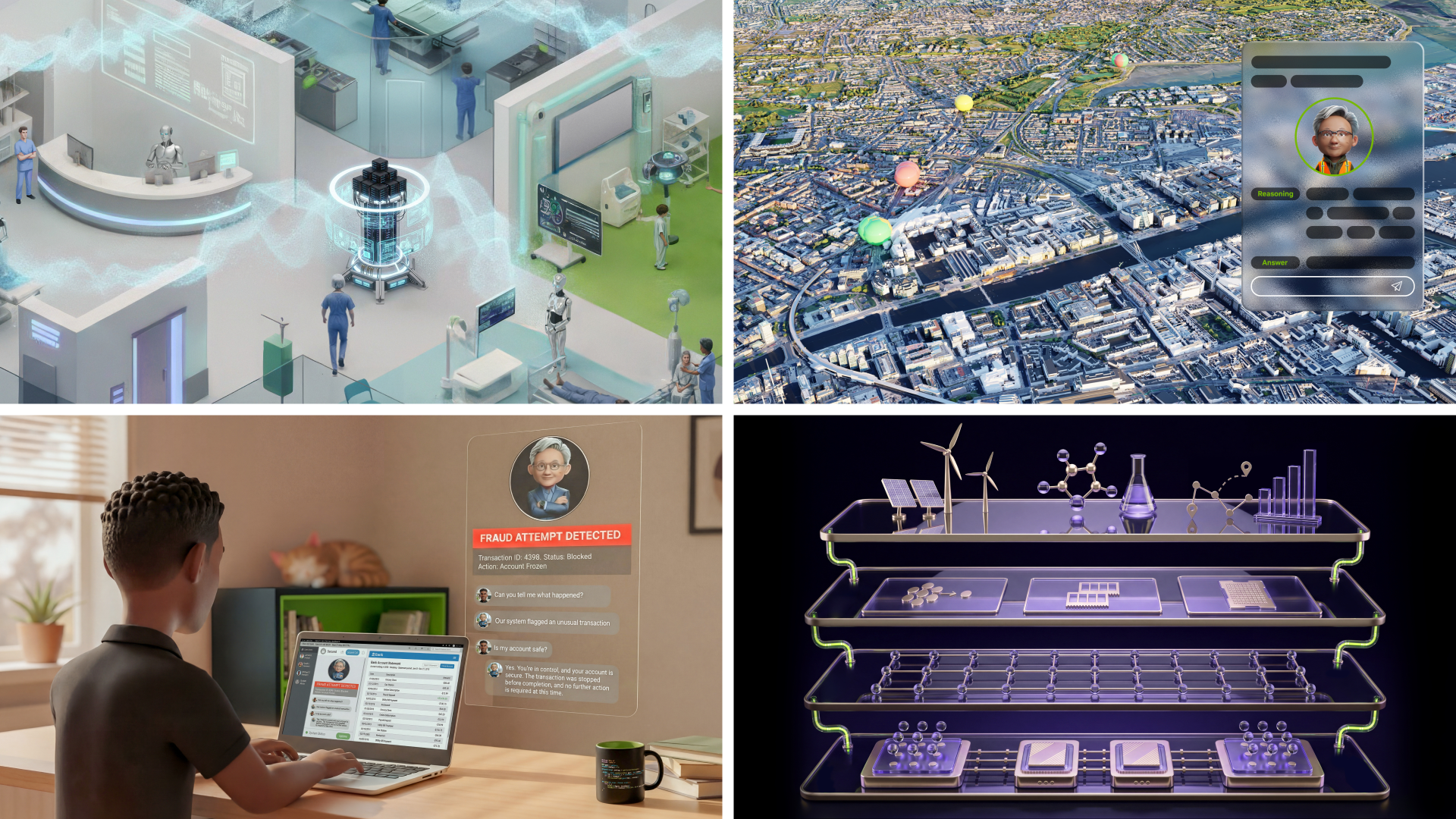 blogs.nvidia.com