SUMMARYResearchers at New York University’s Courant Institute tested several “silly sprinkler” designs to study the reverse sprinkler puzzle in fluid dynamics. Their experiments, published in the Proceedings of the National Academy of Sciences, connect the playful garden devices to a longstanding question associated with Richard Feynman and earlier work by Ernst Mach.
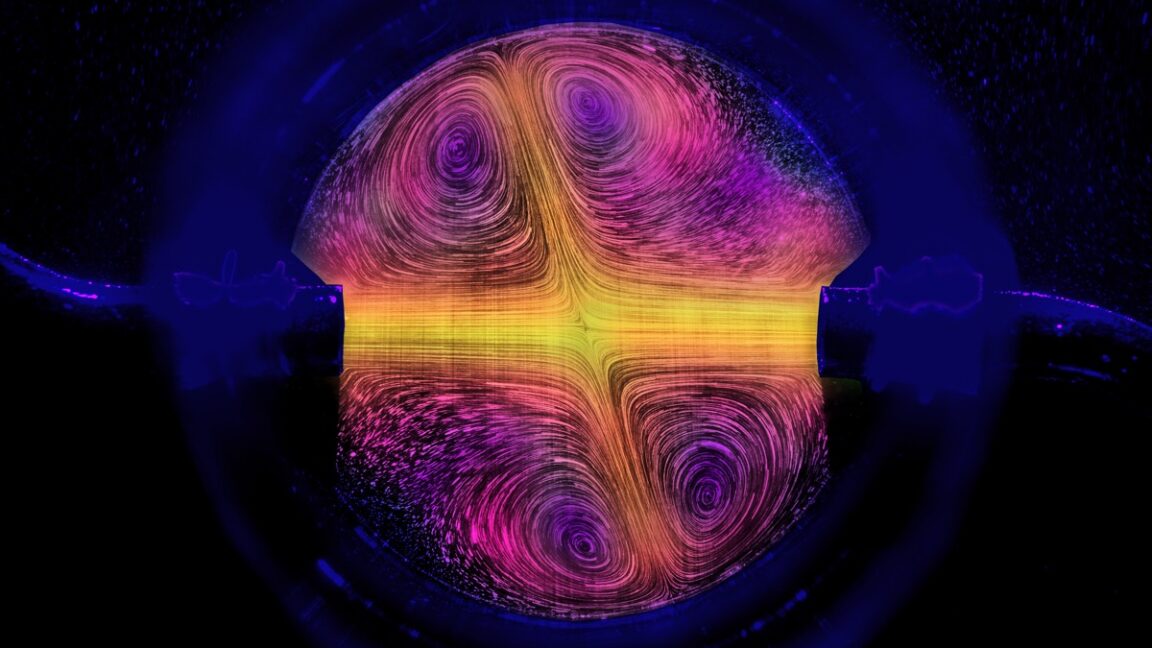
Watering your lawn in the summer can be both pragmatic and fun with so-called "silly sprinklers," designed to create amusing loops and spirals of water jets. And there's some fascinating physics at work to boot. Researchers at New York University's Courant Institute conducted a series of experiments with different silly sprinkler designs to find the answer to a longstanding problem in fluid dynamics, according to a new paper published in the Proceedings of the National Academy of Sciences.
As previously reported, the reverse sprinkler problem is associated with physicist Richard Feynman because he popularized the concept, but it actually dates back to a chapter in Ernst Mach’s 1883 textbook The Science of Mechanics (Die Mechanik in Ihrer Entwicklung Historisch-Kritisch Dargerstellt). Mach’s thought experiment languished in relative obscurity until a group of Princeton University physicists began debating the issue in the 1940s.
Feynman was a graduate student there at the time and threw himself into the debate with gusto, even devising an experiment in the cyclotron laboratory to test his hypothesis. One might intuit that a reverse sprinkler would work just like a regular sprinkler, merely played backward, so to speak. But the physics turns out to be more complicated. “The answer is perfectly clear at first sight,” Feynman wrote in Surely You’re Joking, Mr. Feynman (1985). “The trouble was, some guy would think it was perfectly clear [that the rotation would be] one way, and another guy would think it was perfectly clear the other way.”