SUMMARYJUPITER, Europe’s first exascale supercomputer at Forschungszentrum Jülich in Germany, is powering major research in brain mapping, climate modeling, wireless networking and quantum simulation. Scientists used it to train CytoNet on 6.5 petabytes of brain data in under five days, run the first coupled Earth-system simulation at 1-kilometer resolution, and fully simulate a universal 50-qubit quantum computer. Ericsson and Jülich are also collaborating on AI for 5G and 6G networks using JUPITER as the training platform.
 blogs.nvidia.com
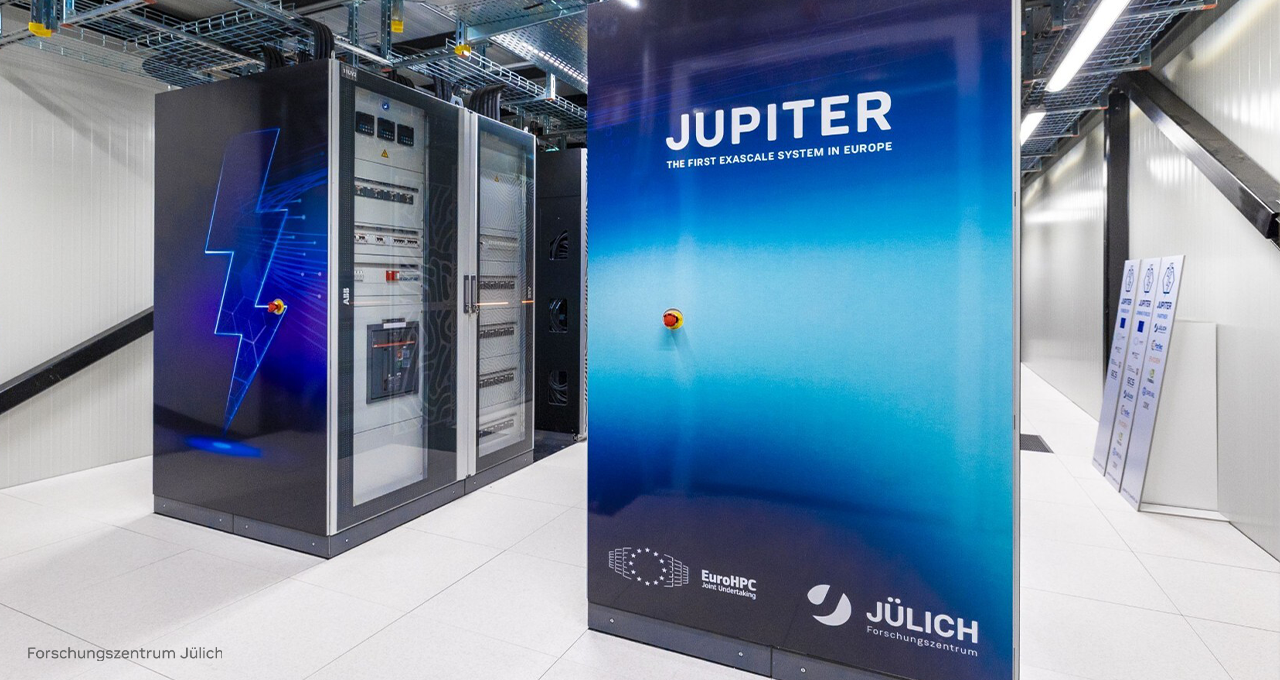
JUPITER, Europe’s first exascale supercomputer at Germany’s Forschungszentrum Jülich, runs on NVIDIA Grace Hopper Superchips and NVIDIA Quantum-X800 InfiniBand networking — and it’s had a busy year.
As the international supercomputing community gathers at ISC in Hamburg this week, four projects running on JUPITER point to what exascale computing can actually do: map the human brain at cellular scale, simulate the entire Earth’s climate at 1-kilometer resolution, build AI systems for the next generation of wireless networks and simulate a universal 50-qubit quantum computer.
“With JUPITER, Europe doesn’t just join the exascale era — it leads it, across the widest range of science and AI of any system worldwide,” said Thomas Lippert, director of the Jülich Supercomputing Centre and professor at Goethe University Frankfurt.
Four projects, detailed below, share a throughline: scientific problems that were out of reach on previous hardware are now tractable at exascale.
A Foundation Model for Mapping the Brain
The Jülich Brain Atlas project — anchored at Jülich’s Institute of Neuroscience and Medicine with partner Helmholtz AI, partner hospital and other Helmholtz institutions — has produced CytoNet, a foundation model for brain microarchitecture analysis.
The complexity of the human brain is astonishing. With 86 billion neurons and about 100 trillion connections between them, understanding brain function at single neuron resolution has been out of reach, until now.
The research is led by neuroscientist Katrin Amunts and computer scientist Christian Schiffer at INM-1, Jülich’s Institute of Neuroscience and Medicine. The model learns from brain imaging data at cellular scale, building a map that links individual cell structures to broader patterns of brain organization and function.
Training ran on JUPITER in under five days, using 6.5 petabytes of data from 21 post-mortem brains on 4,096 NVIDIA Grace Hopper Superchips. A paper describing the work is available on arXiv.
“For the first time, we’re not just using AI to analyze the brain — we’re building an agent that can think through the experiment itself,” said Katrin Amunts, director of INM-1 at Forschungszentrum Jülich and professor of brain research at Heinrich Heine University Düsseldorf. “That changes what neuroscience will be, and JUPITER is what makes that sentence possible to say today.”
That agent is the team’s next step: building an AI agent for brain researchers — integrating multimodal reasoning, language interfaces and Q&A capabilities using open models, including NVIDIA Nemotron 3 120B, working toward AI assistants that can help scientists interrogate brain data directly.
Climate at Kilometer Resolution
A novel ICON configuration — developed by researchers at the ETH Zurich, German Climate Computing Centre (DKRZ), Jülich Supercomputing Centre (JSC), Max Planck Institute for Meteorology, NVIDIA, Swiss National Supercomputing Centre (CSCS) and the University of Hamburg — won the Gordon Bell Prize for Climate Modelling at SC25 last November.
The breakthrough isn’t resolution alone. ICON is the first model to simulate a coupled Earth system at 1-kilometer resolution, with ocean, atmosphere and land, biogeochemistry and the full carbon cycle, with carbon exchanged, between all components. It can simulate and visualize complete ecosystems, such as phytoplankton blooms and zooplankton grazing. Previous systems could model pieces of this; ICON runs it all. This allows a much more precise and complete simulation of the Earth — observable at that level of detail for the first time.
Running on 20,480 NVIDIA Grace Hopper Superchips on JUPITER, the model simulated roughly 146 days of real climate into 24 hours of compute, setting a world record in global climate simulation. NVIDIA’s involvement in the ICON community spans more than a decade.
“Our simulations resolve the fine-scale winds, ocean eddies and upper-ocean mixing that shape marine ecosystems and regulate the ocean’s uptake of carbon,” said Daniel Klocke, computational infrastructure and model development group leader at the Max Planck Institute for Meteorology. “At a global resolution of just 1 kilometer, many of these interactions emerge directly from the laws of physics rather than being approximated. This gives us an unprecedented view of how the atmosphere, ocean and biosphere work together, helping us understand the processes driving our changing climate.”
6G Gets an Exascale Partner
In March, Ericsson and Forschungszentrum Jülich announced a collaboration to develop AI for the continued evolution of 5G and for 6G networks — with JUPITER as the compute engine for large-scale AI model training and testing.
The collaboration targets brain-inspired architectures designed to handle complex network operations at far lower energy costs.
Research priorities include AI models for Ericsson’s radio and core networks, energy-efficient AI inference at the radio edge using neuromorphic approaches, and modular supercomputing architecture concepts drawn from JSC’s exascale work.
Breaking Quantum Records
Researchers at the Jülich Supercomputing Centre (JSC), working with the jointly run NVIDIA Application Lab, also set a world first by fully simulating a universal 50-qubit quantum computer, surpassing the previous 48-qubit record.
The simulation was made possible by drawing on the coherent, tightly coupled CPU-GPU memory architecture of JUPITER’s NVIDIA GH200 Grace Hopper Superchips, which lets data exceeding GPU limits spill seamlessly into CPU memory with minimal performance loss — allowing JUPITER to hold a far greater quantum state than GPU memory alone, which is what pushed the simulation past the previous 48-qubit record.
For now, that kind of simulation is the most powerful tool quantum research has: today’s quantum hardware can’t yet outperform classical computers on useful problems, so simulating quantum machines at the largest possible scale is how researchers design and stress-test the algorithms that future hardware will run.
This powerful quantum simulator, JUQCS-50, will be accessible to explore the performance of quantum algorithm designs within JUNIQ, the quantum computer user facility at JSC, led by Kristel Michielsen, director of JSC and professor at the University of Cologne. JUQCS-50 turns Europe’s first exascale system into a powerful testbed for tomorrow’s quantum-GPU supercomputers.
Exascale’s Impact
The range of science running on JUPITER — from neurons to atmosphere to wireless infrastructure to quantum — makes a case that exascale computing has moved from a research category into production.
The results are a proof point for the Grace Hopper platform at the frontier of science.
Learn more about NVIDIA AI for science.